Business Roadmapping Audit - A Concept of the Future
Jump to navigation
Jump to search
Contents
Building Sustainable Business
- Where will we compete in the future? (hunting grounds)
- How do we intent to compete? (hunting strategies)
- What are future drivers of a sustainable business for our company?
- Will we accomplish such business through market making, market hunting or market farming?
Market Making
- How strongly is the performance of the company's current portfolio influences by the new portfolio influences by the new product choices of the past?
- What needs to be changed in the new products / service portfolio?
- Is the new product portfolio balanced? Are there activities in the portfolio aimed at making the competition irrelavant? Do we have sufficient incremental initiatives to successfully apply leverage on existing platforms?
- How realistic are market predictions? Are we the first mover in the market? Has a Dominant Design already emerged in the market? Is it a Winner-Takes-All market?
- How strong is the price pressure in the market? In the case of a price war, how do we avoid price and profit erosion?
Market Hunting
- Is our sales force empowered? What is the quality of the information the sales force receives? How well is the company equiped to recruit good sales representatives? how well does the company perform in training its sales force? What are the motivation and compensation systems? How does the company monitor sales performance? Do we have enough sales people?
- Is our go-to-market strategy optimized? Are we able to maintain a strong way-to-market architecture? Are capable of appropriating high stable returns?
- Are we Overestimating impact of online channels? Do we truly improve efficiencies or expand the market? Can the middle man effectively be disintermediated? Are the economic benefits fro virtual diversification real?
- Have we positioned our offering firmly in the market mindset?
Market Farming
- What is the lifetime value of our customers? What is the base business of the product or the services the company sells? What is the extended business the company may create by selling other products and services to the same customer? What is the leveraged business the company may derive?
- Does the company have true account management (as opposed to one time sales)? Do we have the right personnel and skills?
- Are our loyalty programs distinctive? Do we have a real perspective changing CRM? Do we have loyal customers who have become true brand ambassadors? Do we succeed in creating expectations?
- Are we capable of determining the right customer processes? Are we well integrated in the customer activities? How high are the Switching costs for customers?
- How consistent is our positioning?
- Is price erosion likely in the near future? How will we react? How effectively are we organized? How professional are we in our Pricing strategy What is the profit we leave on the table?
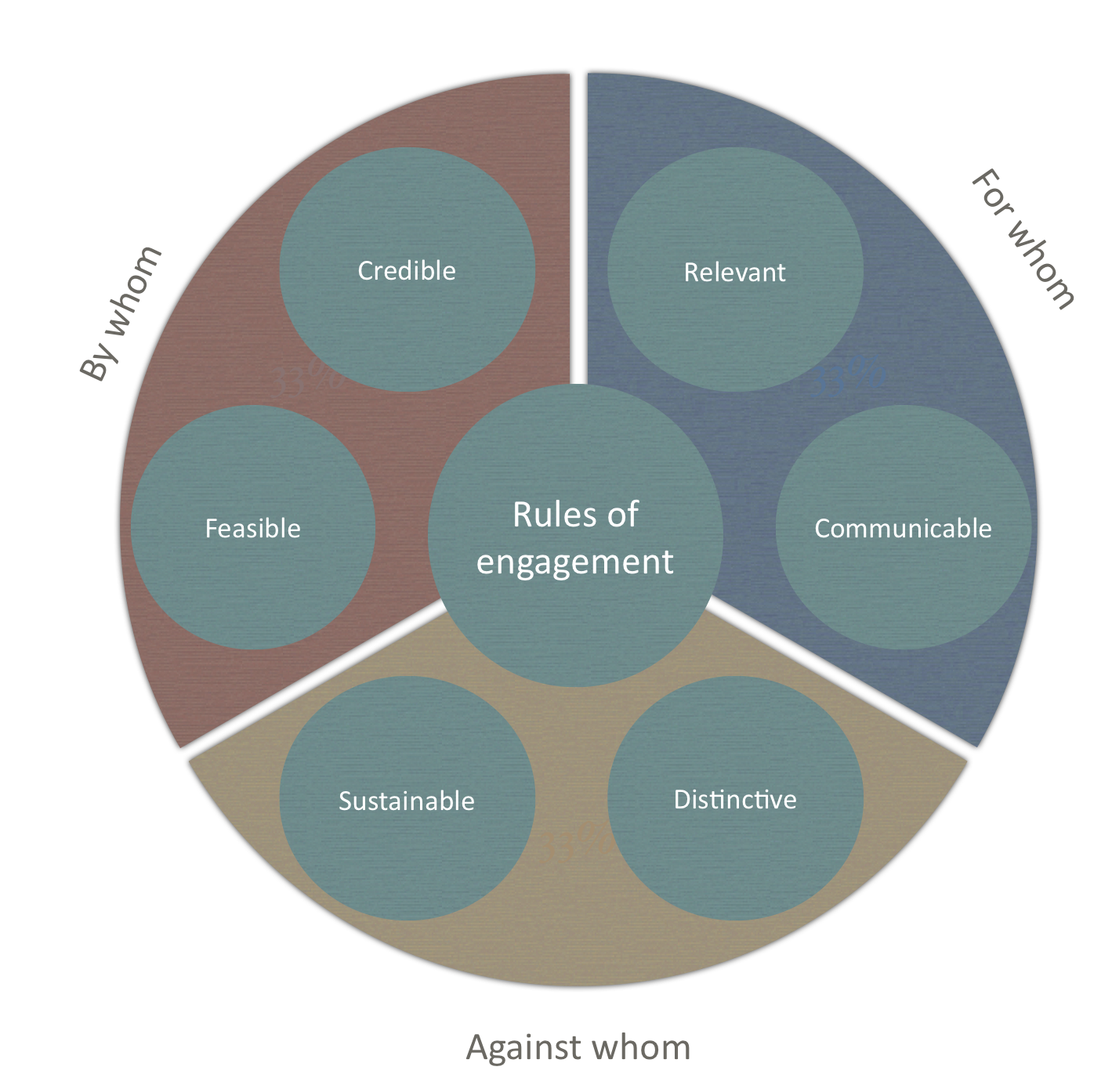
Rules of Engagement
In Marketing Strategy and Organization: Building Sustainable Business the following players in the marketing arena play a role:
- Who is the targeted customer (for whom)
- Marketing is a battle of perceptions. Customer think in terms of brands and symbols. Thus companies must position themselves in dimensions that are Communicable to the target customers.
- The strategy must further be relevant to these customers.
- The quest for a 'mental monopoly' goes along the following lines:
- It is better to be first than it is to be better (law of leadership)
- If you cannot be first in a category then set up a category you can be first in (law of category)
- It is better to be first in the mind than to be first in the market place (law of the mind)
- Who are the competitors (against whom)
- The strategy must be distinguish itself on key customer benefits as perceived by the customer.
- The strategy must be sustainable; the quest for sustainability goes along these lines:
- 'God is always on the side of the big battalions'. Everything else being equal - size does matter
- 'The defensive form of warfare is stronger than the offensive'
- Who is the initiating company (by whom)
- A competitive strategy must, of course, be feasible
- A competitive strategy lastly must be credible. A company cannot completely act against their brand's main values.