Differences in though worlds in product innovation in large firms
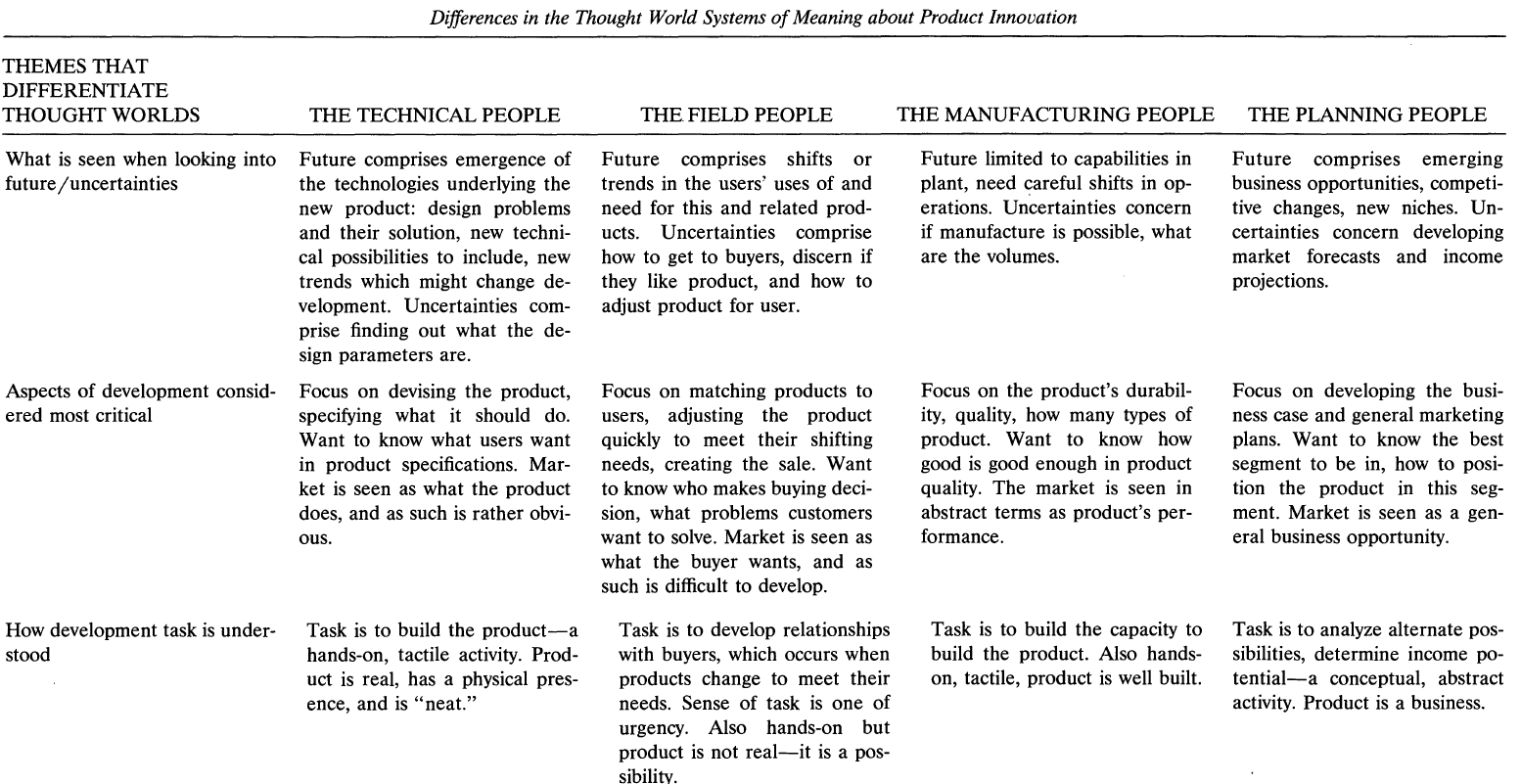 Technical people concentrate on solving design problems and expect field people to tell them exactly what customers want in the design. Field people however cannot identify these specs because in their view users are uncertain. Rather, field people consider that product innovation is to meet shifts in the customer needs and expect technical people to produce alternate designs quickly. Technical people emphasize establishing the product performance specification rather than what the customers does with it.
The field people see constantly emerging customer applications rather than technological possibilities. Such changes are immediate, shifting with the user's model changes or compatitors product or price changes giving them a short term action orientation. Field people empasize the creating or crafting the sale, not the product, and describe this activity as vividly as the engineers discuss disc drives or communication networks.
The manufacturing people are concerned that others do not appreciate their special inflexibilities. They concentrate on reliability and quality, evaluating the product in these terms.
The planning people deal with abstractions of both the technological trends and customer applications. Projecting market size and revenue potential with large uncertainties they deal with 'scenario's rather than concrete opportunities. Concrete thinking colleagues are not always appreciating their work. A technical person in the research said It's hard to know what to do with the reports we get from marketing, a field person said I'll take luck over market research any day.
As an abstraction: "technical people never settle on a design, field people are short term, manufacturing people always say no and planning people are conceptual. Of course all insights are lighting an aspect to the product or market and essential to make the innovation a success. As people are inherent tenant, managers need to proactively foster collective action. Three important messages:
- Three routines enourage thought world seperation and inhibit learning, Succesfull innovators violated all three routines
- Departemental boundaries where governed by narrow roles and limiting relation ships
- A predetermined definition of technology-market issues was imposed on product efforts
- Enforcing of standards which did not fit the new products.
- The succesful innovators did create a new social order for innovation
- The routines in the firms where very strong: breaking out of them to establish an innovative social order seemed to be an unusual and temporary event.
Towards synergy: Technical and field people have a concrete view of development. Reports from conceptual market research therefore may in some occasions be ignored if they do not make sense to them. The field people's close view of customers will bring critical elements to the design but it may also keep them form summarizing specifications that technical people need. Technical people's search for a general design makes them unresponsive to requests for specific changes. Manufacturing people worry about that others do not understand the limits of their plant and go with the 'heels in the sand' Part of M6-S6 - Reading - Dougherty - Interpretative barriers to successful product innovation in large firms
