Selecting strategic options
Selecting strategic options
A marketing plan must be sold, it is an internal tender to the senior management of the firm, aimed at receiving the budget and resources necessary to compete in the coming year. You should be careful not to spread investments too thin: partical commitment is not a realistic option on any strategic task. For an organization two goals should be balances:
- Growth
- Management may aim for the company to be big, it will only accomplish this when the company is strong
- Strength
A company can only grow and maintain competitive by making choices and committing fully to these choices. Michael Porter views that the core task of strategy is what *not* to do!. Managers can use the Criteria for evaluating strategy options to score the impact of a strategy and choose the best one. The Risk/return matrix creates a visual plot of a product portfolio demonstrating risk/reward of different options.
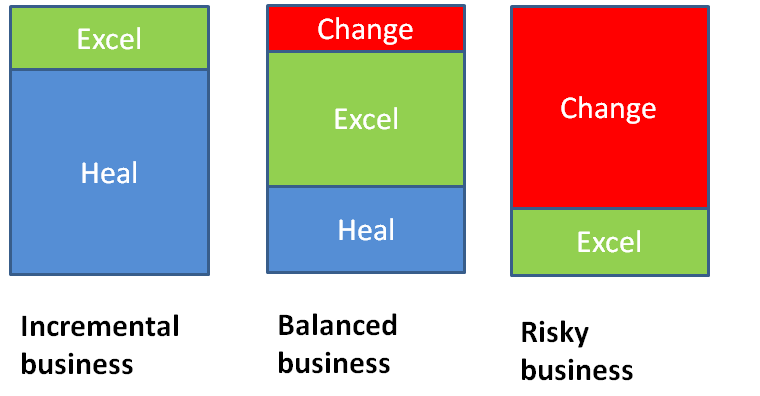
The following distinction is useful when analyzing a strategic option portfolio:
- Heal the company - 40% of the portfolio
- This involves strategic market options aimed at mitigating existing weaknesses. these options can be viewed as hygiene options. Most often they are 'tickets-to-ride' and not 'tickets-to-heaven'/
- Excel at the rules - 40% of the portfolio
- This involves options that conform to existing market rules.
- Change the rules - 20% of the portfolio
- This involves the so-called Blue ocean strategy. The aim is to rewrite the basis of competition in the market, rendering the current business approaches obsolete.
Make sure that the mix is balanced: