Market Segmentation
Market segmentation is a process in which a firms market is partitioned in sub-markets. The objective is to have the response of the marketing activities, products&services vary greatly across segments but have little variation in each segment. It should answer the questions: "Which is (are) my target markets?". The most important question in segmentation is "Do the customers in the target segment want the perceived value that my positioning is trying to deliver MORE than other segments
Other important questions are:
- How can the segment be reached?
- How quickly can the segment be reached?
- How big is the segment?
- What are likely impacts of changes in the environment (economic, lifestyle, legal)?
- What is the current and future competition look like?
When auditing the segmentation of a company one of the most important issues is: "How well is the segmentation reflected in all the other marketing decisions that the venture makes"
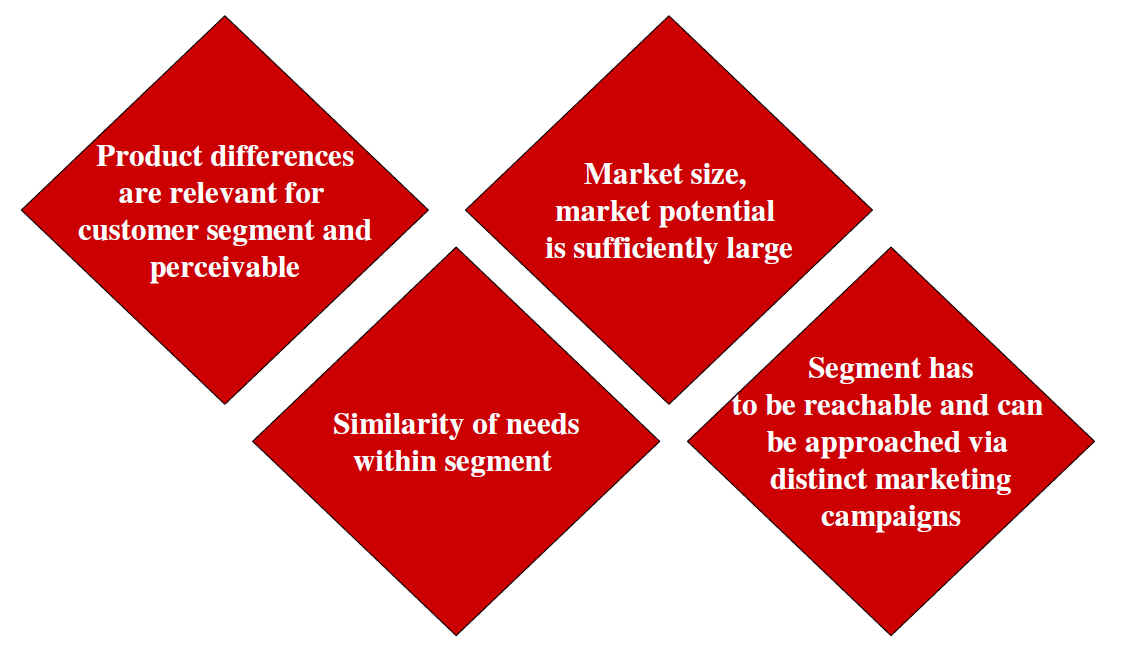
Good customer cegmentation criteria are primairly based on shared customer preferences, a common customer pain or shared customer believes. To be of practical use for a company the following other criteria are of importance:
- Substantial: The segment should result in a substantial size. Cluster the target market in a broad yet comprehensive set of seperate customers groups
- As a guidance, try to divide up your market in a maximum of 10 segments.
- Measurable: The segment should be measurable
- As an example: When targetting 'undisciplined, extravagant spenders' it will be difficult to get a contact database...
- Diffentiable: The segment should be differentiable, meaning that the different segments will respond differently to different elements of the marketing strategy.
- Distinghuising large, midsize and small companies is of no use if you all theat them the same.
- Actionable: The segment should be actionable, meaning that it should be to formulate an appropriate marketing strategy for each segment.
- If your salesforces does not understand the terminology and implications of the marketing strategy, the segmentation is inadequate
- Unique: The segmentation strategy should be unique. You must challenge yourself to have a different view of the market than your competitors.
- Thinking differently will identify new opportunities sooner.
- Attractive: depends on:
- Size of the segment
- Growth rate
- Structural attractiveness
 Profiling Variables are the variables along which Customer Segmentation and Market Segmentation are defined. In consumer markets these variables are defined along the following axes:
- Geographic
- Continents, Countries, States
- Region, Size of City, Climate
- Demographic
- Age, Gender, Income, Lifestyle
- Psychographic
- Personality type and interest, cash-rich, time-poor)
- Lifestyle, Values
- Behavorial
- Purchasing frequency, usage pattern
- Frequency of use, Loyalty, Readiness to buy
See also: Lifestyle Segmentation
The e-Business Market Segmentation Matrix helps to identify participants in an e-Business environment.
See also: Resegment an existing market as a low cost entrant Resegment an existing market as a niche player
Part of M6-S7 - Reading - Lodish - Positioning, Targeting and Segmentation Part of M8-S1 - Reading - Strategies for E-Business - Chapter 3 - External Analysis
