Capital projects as real options
Download the article
The article describes an approach to use option value theory to help with in company project investment decisions. There are several examples where using real option analysis give a better view of your project:
- An R&D program may both:
- generate a cash producing new product , as well as
- opportunities for further R&D aimed to create yet more new products
- Investing in a new market may:
- Lead to immediate cash flow, as well as,
- Future expansion possibilities
- Replacing:
- a first-generation technology with a second, makes it possible to eventually,
- replace the second with a third
All of the above examples, contain Assets in place (first bullet item) and growth options (second bullet item). The value of the growth options are discarded in traditional DCF analysis.
The article goes on to describe the concept of NPV_q, Options and Real Options. The final 'punch line' of the article is the following diagram:
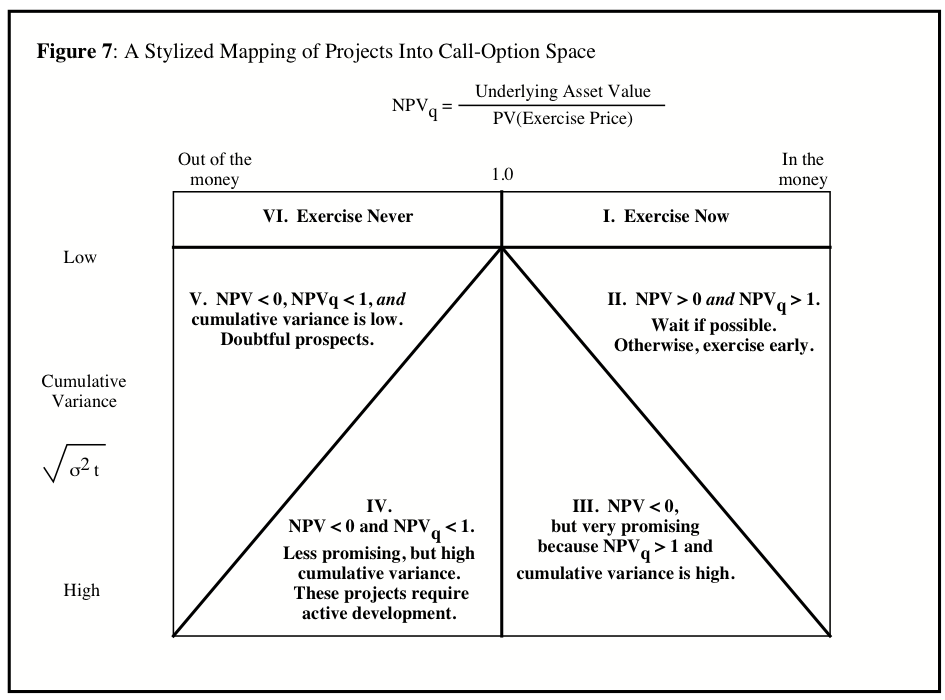
Note to myself: Quadrant 3 lists NPV < 0 which was counter intuitive at first'. The reason this can happen is that if the risk free rate of return is > 0. The location of this curve varies with r and σ. The curve is located by holding r and σ constant as t varies, and solving for the NPV_q that corresponds to NPV=0. Note that in the extreme case of r=0, the curve is a vertical line passing through NPV_q =1. As r increases, the slope of the curve decreases, bending to the right, as shown in Figure 6.
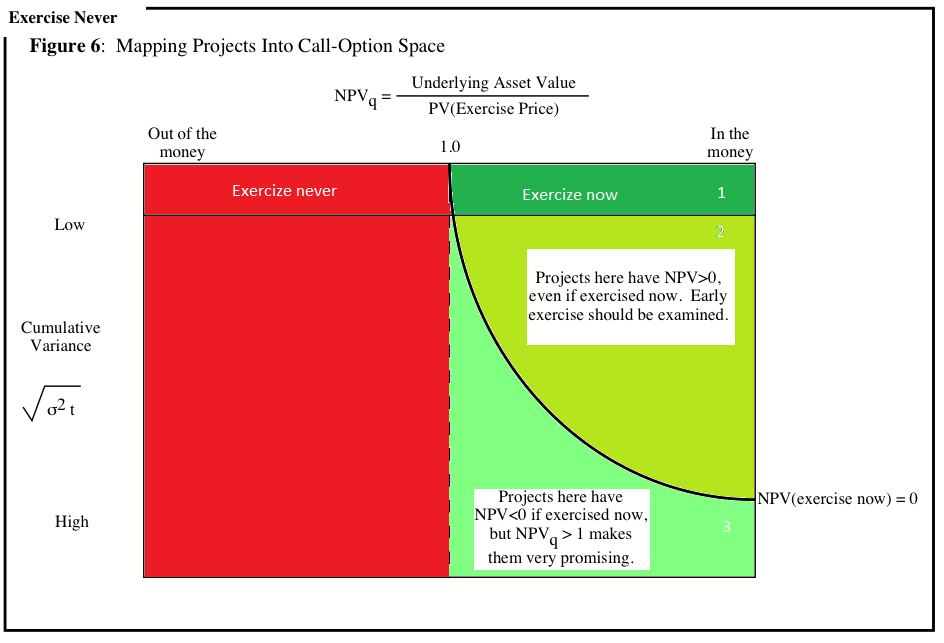
In the graph above there are three sitiuations:
- At the top there are options with no cumulative variance, either time has run out or there is no variance. These options are in the money and should be exercised immediately. There is no value in waiting.
- Just below are options that are in the money but for which there is still some cumulative variance. The company should wait, if possible, to exercise these options. Early exercise may be desirable when the underlying asset is 'wasting' (subject to competitors actions)
- Finally at the bottom there are options that are promissing because NPV_q > 1 even though NPV < 0. If, as time runs out, neither S nor X changes, then NPV_q will fall and these options will expire unexercised. But in a large sample of projects, many of them may end 'in the money'
