Difference between revisions of "Outpacing strategies"
Jump to navigation
Jump to search
(Replaced content with "Outpacing strategies Category:mbi Category:Term") Tag: Replaced |
|||
| Line 1: | Line 1: | ||
| − | + | The underlying assumption that there is a need to choose between [[Cost leadership strategies|Cost leadership strategies]] and [[Differentiation strategies|Differentiation strategies]] is that there is a trade-off: a high level of quality usually entails higher cost. A firm that tries both has the risk of becoming 'Stuck in the middle'. | |
| + | |||
| + | <html> | ||
| + | <img src="/static/files/MBI/Module%208/outpacingstrategy.PNG" width=350> | ||
| + | </html> | ||
| + | |||
| + | The following factors can undermine the traditional trade-off's: | ||
| + | * Development of new technologies | ||
| + | * Wastefulness | ||
| + | * Economies and scale and learning effects | ||
| + | Part of [[M8-S2 - Reading - Strategies for E-Business - Chapter 5 - Strategy options|M8-S2 - Reading - Strategies for E-Business - Chapter 5 - Strategy options]] | ||
[[Category:mbi]] | [[Category:mbi]] | ||
[[Category:Term]] | [[Category:Term]] | ||
Latest revision as of 20:01, 27 August 2020
The underlying assumption that there is a need to choose between Cost leadership strategies and Differentiation strategies is that there is a trade-off: a high level of quality usually entails higher cost. A firm that tries both has the risk of becoming 'Stuck in the middle'.
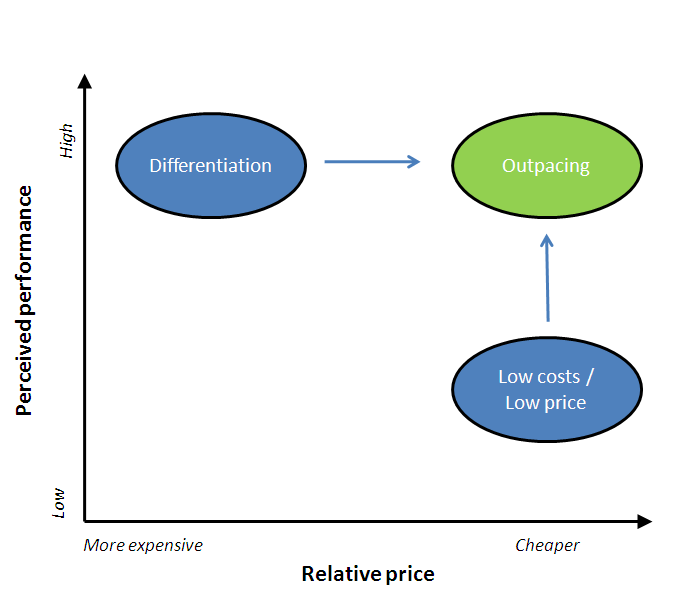
The following factors can undermine the traditional trade-off's:
- Development of new technologies
- Wastefulness
- Economies and scale and learning effects
Part of M8-S2 - Reading - Strategies for E-Business - Chapter 5 - Strategy options
