Difference between revisions of "Criteria for evaluating strategy options"
Jump to navigation
Jump to search
(Replaced content with "Criteria for evaluating strategy options Category:marketing Category:M11 Category:M11-S1 - Reading - Marketing Strategy and Organization - Chapter 6 - Shaping...") Tag: Replaced |
|||
| Line 1: | Line 1: | ||
| − | + | Research has shown that the following criteria are generally used for evaluating strategy options: | |
| + | |||
| + | |||
| + | <html><img src = "/static/files/MBI/Module%2011/scoreboardstrategicoptions.PNG" width="500"/></html> | ||
| + | |||
| + | |||
| + | =Business Opportunity - Size the prize= | ||
| + | The 'prize' to aim for can contain a number of elements: | ||
| + | * Increase in market share | ||
| + | * Increase in customer share | ||
| + | * Access to new markets or distribution channels | ||
| + | * Maintaining or increasing prices | ||
| + | * Increasing margins | ||
| + | * Increasing business process efficiency | ||
| + | * Increasing appropriability of revenues | ||
| + | * Increasing the economic value added | ||
| + | * EEtc. | ||
| + | Each opportunity can represent an increase of 1) revenue, 2) reduce costs or 3) both | ||
| + | =Competitiveness - Can we win?= | ||
| + | # Often a strategy is developed solely by '''''Looking at opportunities and threats''''' | ||
| + | # Another dimension is to '''''seek a competitive advantage to build'''''. Does it provide a small or substantial improvement to the existing advantages? Will you look at the current arena or new ones? (See also [[Strategic game-board|Strategic game-board]]) | ||
| + | # The third criterion is to '''''Look at the sustainability of the created competitive advantage''''' | ||
| + | * Feasibility - Can we do it? | ||
| + | # Choosing the right moment | ||
| + | ## The concept of the [[The Tipping Point|The Tipping Point]] may be applied in organizational decision making in times of inertia. A good metaphor is for inducing change is the game of domino. Is the heaviest 'domino' (senior management) ready to fall over? | ||
| + | # Resource requirement | ||
| + | ## To what degree must core processes be changed? | ||
| + | # Flexibility | ||
| + | ## What opportunities remain to adjust after the projects are implemented? | ||
| + | # Team | ||
| + | ## The quality of the team that proposes the strategic options is crucial: are the people heavyweight or lightweight? | ||
| + | =Leverage= | ||
| + | Critical options to consider leverage effects are: | ||
| + | # Future spin-offs which may follow from this investment | ||
| + | # Potential business opportunities outside the business unit to other business with the same corporation | ||
| + | # The negative spill overs within the business or across business which may follow from investment in the project. | ||
| + | |||
[[Category:marketing]] | [[Category:marketing]] | ||
Latest revision as of 19:48, 27 August 2020
Research has shown that the following criteria are generally used for evaluating strategy options:
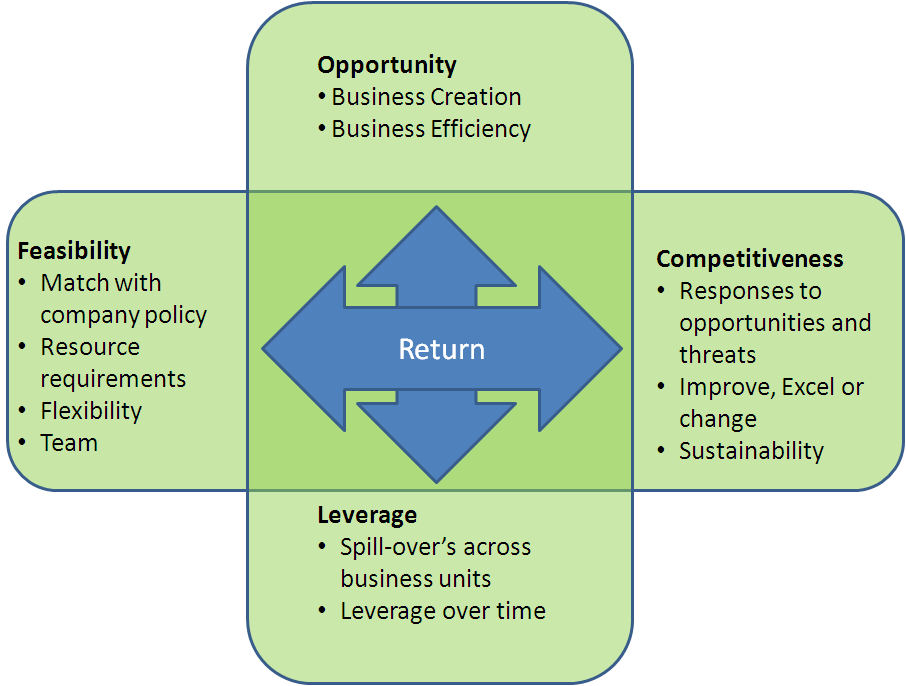
Business Opportunity - Size the prize
The 'prize' to aim for can contain a number of elements:
- Increase in market share
- Increase in customer share
- Access to new markets or distribution channels
- Maintaining or increasing prices
- Increasing margins
- Increasing business process efficiency
- Increasing appropriability of revenues
- Increasing the economic value added
- EEtc.
Each opportunity can represent an increase of 1) revenue, 2) reduce costs or 3) both
Competitiveness - Can we win?
- Often a strategy is developed solely by Looking at opportunities and threats
- Another dimension is to seek a competitive advantage to build. Does it provide a small or substantial improvement to the existing advantages? Will you look at the current arena or new ones? (See also Strategic game-board)
- The third criterion is to Look at the sustainability of the created competitive advantage
- Feasibility - Can we do it?
- Choosing the right moment
- The concept of the The Tipping Point may be applied in organizational decision making in times of inertia. A good metaphor is for inducing change is the game of domino. Is the heaviest 'domino' (senior management) ready to fall over?
- Resource requirement
- To what degree must core processes be changed?
- Flexibility
- What opportunities remain to adjust after the projects are implemented?
- Team
- The quality of the team that proposes the strategic options is crucial: are the people heavyweight or lightweight?
Leverage
Critical options to consider leverage effects are:
- Future spin-offs which may follow from this investment
- Potential business opportunities outside the business unit to other business with the same corporation
- The negative spill overs within the business or across business which may follow from investment in the project.
