The AAA Triangle
Jump to navigation
Jump to search
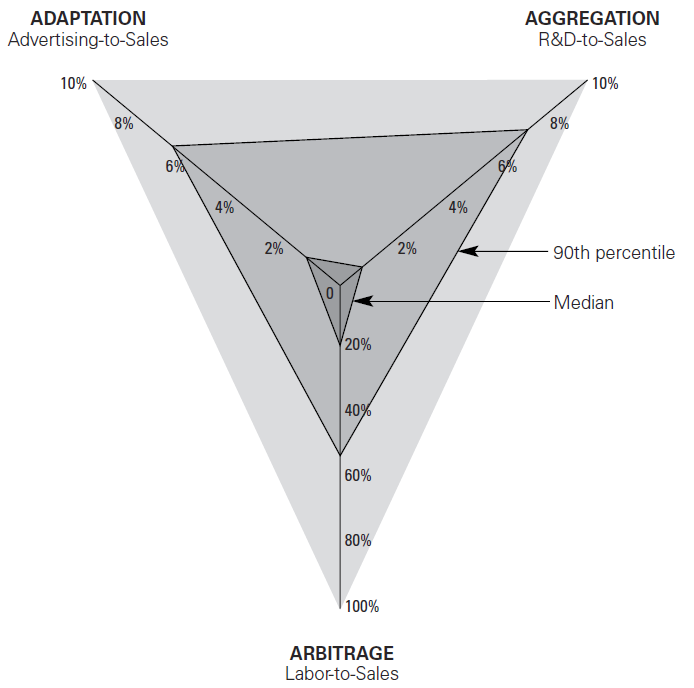
In M21-S8 - Article - Managing Differences the AAA triangle is defined to include three measures to manage differences in 'distance' between companies (see M21-S2 - Article - Distance Still Matters):
- Aggregation
- With the strategy of Aggregation a company tries to achieve economies of scale by standardizing regional or global operations.
- Adaptation
- With the strategy of Adaptation a company tries to boost market share by adapting process and offerings to meet local needs.
- Arbitrage
- With the strategy of Arbitrage a company exploits differences and local strengths, for instance by outsourcing labor to lower wages countries.
The percentage of sales spend on advertising is a metric on how important Adaptation is for the company. The percentage of R&D is an indication of the importance for Aggregation and the percentage spent on labor helps gauge the importance of Arbitrage.
| Adaptation | Aggregation | Arbitrage | |
|---|---|---|---|
| Competitive advantage Why globalize at all? |
To achieve local relevance through national focus while exploiting some economies of scale | To achieve economies of scale and scope through international standardization | To achieve absolute economies through international specialization |
| Configuration Where should we locate operations overseas? |
Mainly in foreign counties that are similar to the home base, to limit the effects of cultural, administrative, geographic and economic distance | Same as adaptation | In a more divers set of countries, to exploit some elements of distance |
| Coordination How should we connect international operations? |
By country, with emphasis on achieving local presence withing borders | By business, region or customer, with emphasis on horizontal relationships for cross border economies of scale | By function with emphasis on vertical relationships, even across organizational boundaries |
| Controls What types of extremes should we watch for? |
Excessive variety or complexity | Exessive standardization, with emphasis on scale | Narrowing spreads |
| Change Blockers Whom should we watch out for internally? |
Entrenched country chiefs | All-powerful unit, regional or account heads | Heads or key functions |
| Corporate Diplomacy How should we approach corporate diplomacy |
Address issues of concern but proceed with discretion, given the emphasis on cultivating local presence | Avoid the appearance of homohenization or hegemonism (especially for U.S. companies), ben senistive to any backlash | Address the exploitation or displacement of suppliers, channels or intermediaries, which are potentially most prone to political disruption. |
| Corporate Strategy What strategic levers do we have? |
Scope selection Variation Decentralisation Partitioning Modularization Flexibility partnership Recombination Invocation |
Regions and other country groupings Products or business Function Platform Competence |
Cultural (country of origin effects) Administrative (taxes, regulations, security) Geographic(distances, climate) Economic (Differences in prices, resources, knowledge) |
