Situational Leadership
According to the creators at [Blanchard] Situational Leadership® II (SLII®) is the most comprehensive, up-to-date, and practical method of effectively managing and developing people, time, and resources in the world. SLII provides leaders with a model and the tools for creating open communication and developing self-reliance in those they manage. It is designed to increase the frequency and quality of conversations about performance and development. As a result, competence is developed, commitment is gained, and talented individuals are retained
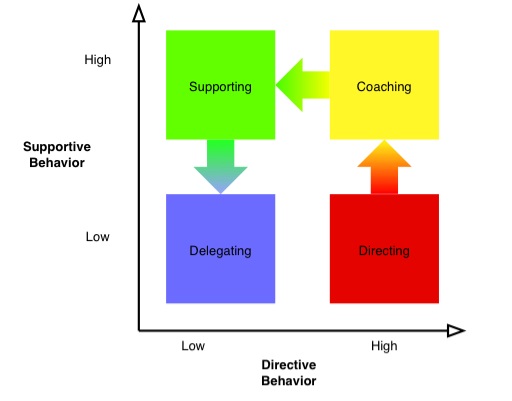
| Phase | Description |
|---|---|
| Directing | Leader shows how to do it |
| Coaching | Leader is in control but team member defines how |
| Supporting | Team member is control under supervision |
| Delegating | Team is fully capable and reports to leader on an as needed basis |
From my own experience, situational leadership helps most while being explicit about the leadership style to use for each team members learning and development goals. It may also be the case that you as a leader are no the ideal coach for each learning topic and learning phase. Sometimes, leader and team member have a different understanding on the maturity level of the team member.
By making the learning goal, situational leadership style and coach explicit, a lot of misunderstandings can be avoided. I learned Situational Leadership in combination with [[1]] from [Jerome]
