Coaching
In Situational Leadership the Coaching leadership style is where the leader is highly supportive and encourages the employee. The following attributes are applicable:
- Leader clarifies goals, roles and performance expectations with input from team member
- Leader assigns tasks, and provides resoucres and training with input from team member
- Leader identifies and explains problems, and solves problems with input from team member
- Leader makes and explains decisions after hearing team members ideas, opinions and concerns; two-way communication increases
- Leader continues to direct, observe and evaluate task accomplishment
- Leader praises performance on the right track
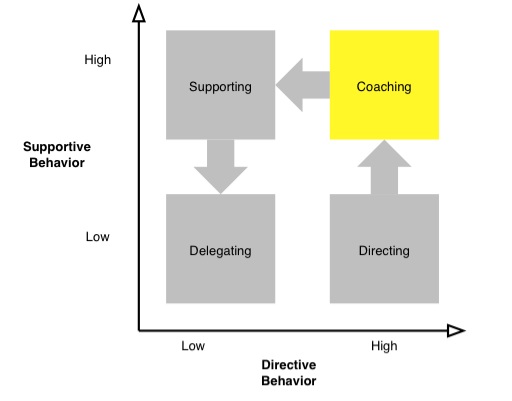
Coaching
(text below copied from http://www.business-leadership-qualities.com/situationalleadership-c.html)
In the Coaching phase of the model, the follower now has a basic grasp of the task or job, though is not yet independently proficient. The leader's role then is to coach; that is, to have the follower do as much of the task as he or she is able and to step in when the follower has questions, hits a road block, or is going off track.
For example, a subject matter expert decides she wants to be a trainer. She takes a train the trainer course. At this point, she grasps what training is, how to structure it, how to involve the participants and how to do knowledge checks. Great!
However, the second she walks into a classroom, she will realize that there is a great deal about group dynamics and how to facilitate that she has yet to master. So, best case, she could co-train with the leader, receive real time coaching and improve her facilitation skills.
Leadership Tips
Be alert to the follower who is enthusiastic but doesn't yet know what they don't know. Be ready with a safety net!
