Delegating
In Situational Leadership the Delegating leadership style is where the leader is both low on support as direction. The following bullets characterize this leadership style:
- Team member recommends goals, roles, and performance expectations to leader for approval, as needed
- Team member plans tasks, idenitifies problems and implements solutions with littly to no leader involvement
- Team member is empowered to act independently with appropriate resources to complete the task
- Team member is fully accountable for deliverables, assesses and improves his own work, and takes the credit
- Leader recognizes and awards winning performance, challenges team member to higher expectations, and periodically fcusses on team member results and future plans
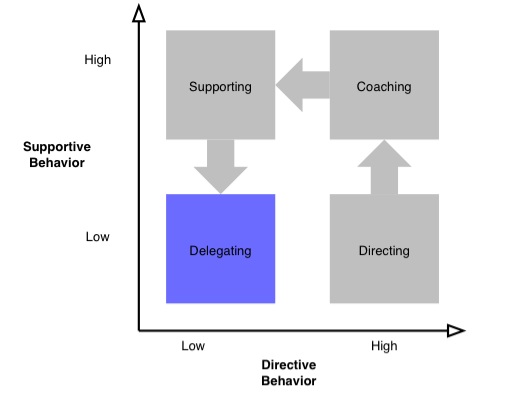
Delegating
(copied from http://www.business-leadership-qualities.com/situationalleadership-de.html) The fourth phase of Situational Leadership is Delegating. This is when the follower is fully confident and competent. The leader, at this phase, should entrust the task or job to the follower.
Being able to delegate is the nirvana of managers, however, to delegate successfully, all four phases should be completed thoroughly. Skipping a phase can lead to frustration on the part of both leader and follower.
Let say our Subject Expert volunteers to become a trainer. Her manager says "Great. We have some good books on training in the library. Why don't you start there." As you can probably guess, sending the Subject Expert from the library (directing) to the classroom (delegating) won't work well unless the Subject Expert has a LOT of talent.
The manager recognizes that and says, "Why don't you sign up for a train-the-trainer course (coaching)." Going from Coaching to Delegating might work a bit better, but there is still some risk. The Subject Expert may go into the classroom and be thrown off stride by unexpected group dynamics or questions she hadn't anticipated. She becomes disillusioned by the experience and decides to quit training. The manager's investment is lost.
Having a senior trainer present to support and give feedback would help the Subject Expert through the unexpected and help her gain confidence for next time.
Now she's ready to take the class herself and the company's investment of time and money will have a return.
The key to effective Situational Leadership is to use all four phases, to go to a prior phase when necessary, and to adjust the time in each phase to the aptitude of the follower.
