Motivating Salespeople: What Really Works - Harvard Business Review
URL
http://hbr.org/2012/07/motivating-salespeople-what-really-works/ar/1
Description
Sales executives are always looking for ingenious ways to motivate their teams. They stage grand kickoff meetings to announce new bonus programs. They promise exotic trips to rainmakers. When business is slow, they hold sales contests. If sales targets are missed, they blame the sales compensation plan and start from square one.
A Performance Curve for the Sales Force
Accounting for individual differences raises the odds that a compensation plan will stimulate the performance of all types of salespeople. In this article we will discuss how companies can do this to deliver greater returns on investment and shift their sales-performance curve upward.
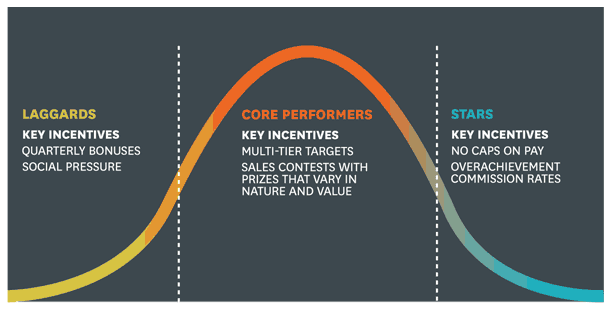
- Core performers usually represent the largest part of the sales force, and companies cannot make their numbers if they’re not in the game. Here are some proven strategies for keeping them there.
- Laggards the low-performing group in a sales force is usually heterogeneous: It may include new hires in need of training and senior salespeople who have become complacent, as well as people who are simply less talented and motivated than their colleagues. Most laggard groups we’ve observed have members whose performance can improve if the right incentives are in place.
- Stars Since stars represent the most efficient portion of a company’s performance curve, incentive plans should favor them. Yet in many companies sales commission rates are capped and winner-take-all prize structures dominate the incentives.
| Group | Motivation | Explanation |
|---|---|---|
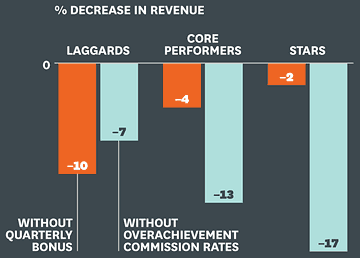
| Core Performers | Multi-tier targets | Core performers striving to achieve triple-tier targets significantly outsold core performers given only two tiers. By contrast, multi-tier targets did not motivate stars and laggards as much: No significant differences in performance were found for those segments |
| Prizes | The key is to offer gifts (not cash) for the lower-level prizes that can be seen as equal, or even superior, to the top-level prizes on some dimension. This approach won’t work if the gifts offered at lower performance tiers are simply lower-grade versions of those at the top tier. The lower-level prize must have some quality that the higher-level one does not | |
| Laggards | Pace-setting bonuses | Frequent (quarterly) bonuses. There is no downside to including quarterly bonuses. They help laggards contribute to the bottom line without detracting from the performance of other groups |
| Natural social pressure | Having a high-quality pipeline of new sales talent naturally puts social pressure on lowperforming salespeople. Salespeople in districts with a bench player perform approximately 5% better than those without one. The greatest increase in performance takes place in the laggard group. In the long run the overall increase in revenue easily outweighs the additional costs associated with hiring bench players. | |
| Stars | No ceiling on commissions | By eliminating it and making other changes to the compensation plan, a company kept its salespeople motivated and increased revenue |
| Overachievement commissions | Have higher rates that kick in after quotas are met | |
| Multiple winners | Multiple winners boost sales effort and performance better than contests with winner-take-all prize structures.Prizes should be awarded as the proportion of stars increases. Executives should offer at least as many prizes as there are stars in a sales force. Increasing the number of prizes in a contest increases the chances that a laggard or a core performer will win a prize in place of a star, which motivates stars to work harder. |
= Shift Your Performance Curve Upward=
Sales compensation plans that take into account the different needs of different salespeople—and that are based on real evidence rather than assumptions—will ensure that your sales department gets a significantly higher return on its investments.