Theory of Constraints
Jump to navigation
Jump to search
The Theory of Constraints. TOC is elegantly simple. Throughput (T) is the critical index of performance. Inventory (I) and Operating Expense (OE) are the other two.
- Identify the constraint. The weakest link that limits the system’s capacity. The system’s efficiency, the system’s throughput rate, the system’s cost, is defined solely by the weakest link. It may be a physical or behavioral constraint. Look for piles of built-up inventory
- Exploit the constraint. Use 100%. Maximize the performance of the constraint. That pace is the heartbeat of the operation. Usually, there are multiple steps that increase this throughput rate.
- Subordinate everything else to the constraint. All other processes support the constraint, even if some portions of the process are made less efficient or actually slow down. Capacity lost on a non-bottleneck has no effect. That resource had extra capacity anyway.
- Elevate the constraint. If performance cannot meet demand, acquire more capability.
- Once constraint is addressed, go back to step (1). TOC is iterative. Once one constraint is solved, the next slowest process becomes the new constraint. The real constraints are usually policies, not procedures or machines!
Rule 1: Balance Flow, not Capacity
Line balancing, which is an example of tradition system, attempts to balance the capacity of each work-station. Work-stations are so designed that their capacity is nearly same and, hence, there is a high utilization factor. OPT, using TOC on the other hand, focuses on balancing the flow within the plant (rather than resources as in line-balancing). This will ensure the identification of bottleneck (on constraint). Once the bottleneck is handled for improvement, the throughput of the system increases.
Rule 2: The level of utilization of a non-bottleneck resource is determined not by its own potential but by some other constraint in the system.
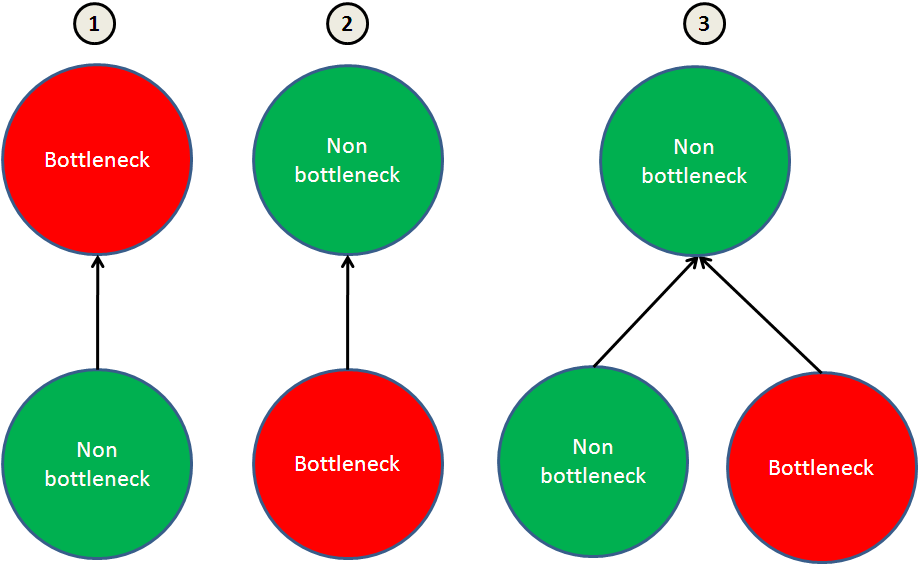
There are several types of situations:
- A non-bottleneck feeding into a bottleneck
- Need to create a (time) buffer to compensate for possible problems with delivery earlier in the chain
- A bottleneck feeding into a non-bottleneck
- (no attention required)
- A dependency