Confidence interval
A 95 per cent confident for a population mean looks like.
Failed to parse (unknown function "\huge"): {\displaystyle \huge \mu = {\bar x}\pm1.96\frac{\sigma}{\sqrt n}}
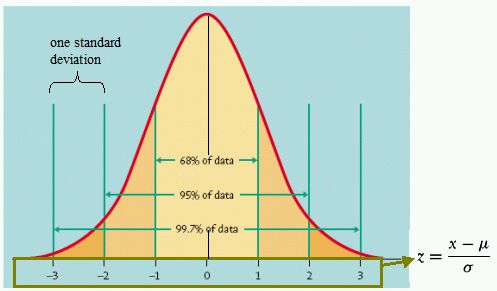
In practice we seldom know that is known. Therefore most of the times an estimate of standard deviation in the sample (sometimes denoted as Failed to parse (unknown function "\Large"): {\displaystyle \Large\hat\sigma} ) is used:


Failed to parse (unknown function "\huge"): {\displaystyle \huge \mu = {\bar x}\pm z\frac{s}{\sqrt n}}
If we use: Failed to parse (unknown function "\huge"): {\displaystyle \huge e=z \frac {s}{\sqrt n}}
We can make a conclusion on determining the minimum sample size given a requested error level and confidence level:: Failed to parse (unknown function "\huge"): {\displaystyle \huge n=(\frac {zs}{e})^2}
Adding up confidence intervals for the difference of means is given by: Failed to parse (unknown function "\huge"): {\displaystyle \huge (\mu_1 - \mu_2) = (\bar{x_1} - \bar{x_2}) \pm \sqrt{(\frac{s_1^2}{n_1^2}+\frac{s_2^2}{n_2^2})}}
When the sample size comes closer to the population size, the error will become smaller. Using the finite population correction factor this can be taken into account:
Failed to parse (unknown function "\huge"): {\displaystyle \huge \sqrt {(1-\frac {n}{N})}}
So corrected with the finite population correction factor a 95 per cent confident for a population mean looks like: Failed to parse (unknown function "\huge"): {\displaystyle \huge \mu = {\bar x}\pm 1.96 \sqrt {(1-\frac {n}{N})} \frac{s}{\sqrt n}}
The T-distribution can be used instead of the Normal distribution when defining confidence intervals when sample size is small or the standard deviation is unknown.
Part of M7-Quantitative Decision Methods-S3 - Normal Distribution and confidence intervals
