The Five Dysfunctions of a Team: A Leadership Fable
<<formTiddler <missing '>>'>NewBookTemplate>>
{"Author":"Patrick Lencioni"}
Contents
Summary
(copied from http://www.tablegroup.com/books/dysfunctions/Conquer%20Team%20Dysfunction.pdf)
Like it or not, all teams are potentially dysfunctional. This is inevitable because they are made up of fallible, imperfect human beings. From the basketball court to the executive suite, politics and confusion are more the rule than the exception. However, facing dysfunction and focusing on teamwork is particularly critical at the top of an organization because the executive team sets the tone for how all employees work with one another.
A former client, the founder of a billion dollar company, best expressed the power of teamwork when he once told me, "If you could get all the people in the organization rowing in the same direction, you could dominate any industry, in any market, against any competition, at any time."
Whenever I repeat this adage to a group of leaders, they immediately nod their heads, but in a desperate sort of way. They seem to grasp the truth of it while simultaneously surrendering to the impossibility of actually making it happen. Fortunately, there is hope. Counter to conventional wisdom, the causes of dysfunction are both identifiable and curable. However, they don't die easily. Making a team functional and cohesive requires levels of courage and discipline that many groups cannot seem to muster.
The five dysfunctions
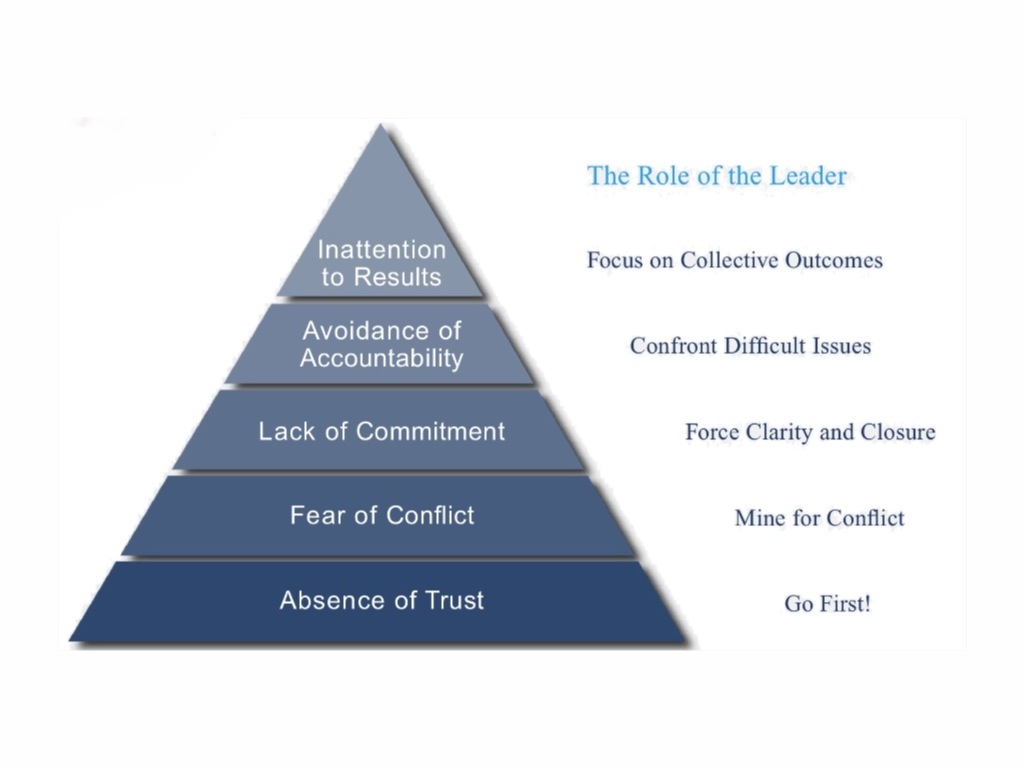
- Absence of Trust
- The fear of being vulnerable with team members prevents the building of trust within the team.
- Fear of Conflict
- The desire to preserve artificial harmony stifles the occurrence of productive, ideological conflict.
- Lack of Commitment
- The lack of clarity or buy-in prevents team members from making decisions they will stick to.
- Avoidance of Accountability
- The need to avoid interpersonal discomfort prevents team members from holding one another accountable for their behaviors and performance.
- Inattention to Results
- The pursuit of individual goals and personal status erodes the focus on collective success.
Addressing the Dysfunctions
To begin improving your team and to better understand the level of dysfunction you are facing, ask yourself these simple questions:
- Do team members openly and readily disclose their opinions?
- Are team meetings compelling and productive?
- Does the team come to decisions quickly and avoid getting bogged down by consensus?
- Do team members confront one another about their shortcomings?
- Do team members sacrifice their own interests for the good of the team?
Although no team is perfect and even the best teams sometimes struggle with one or more of these issues, the finest organizations constantly work to ensure that their answers are "yes." If you answered "no" to many of these questions, your team may need some work.
The first step toward reducing politics and confusion within your team is to understand that there are five dysfunctions to contend with, and address each that applies, one by one.
Conquer Team Dysfunction
Dysfunction #1: Absence of Trust
This occurs when team members are reluctant to be vulnerable with one another and are unwilling to admit their mistakes, weaknesses or needs for help. Without a certain comfort level among team members, a foundation of trust is impossible.
Dysfunction #2: Fear of Conflict
Teams that are lacking on trust are incapable of engaging in unfiltered, passionate debate about key issues, causing situations where team conflict can easily turn into veiled discussions and back channel comments. In a work setting where team members do not openly air their opinions, inferior decisions are the result.
Dysfunction #3: Lack of Commitment
Without conflict, it is difficult for team members to commit to decisions, creating an environment where ambiguity prevails. Lack of direction and commitment can make employees, particularly star employees, disgruntled
Dysfunction #4: Avoidance of Accountability
When teams don't commit to a clear plan of action, even the most focused and driven individuals hesitate to call their peers on actions and behaviors that may seem counterproductive to the overall good of the team.
Dysfunction #5: Inattention to Results
Team members naturally tend to put their own needs (ego, career development, recognition, etc.) ahead of the collective goals of the team when individuals aren't held accountable. If a team has lost sight of the need for achievement, the business ultimately suffers.
More Key Points
Common team goals lead individuals to making better decisions, seeing beyond their own potentially narrow self interests and really moving the needle in the corporate world. The catch is simple: building and maintaining a team is hard work and can force even the most seasoned professional well outside of their traditional comfort zones. Professionals have disparate work habits, communication styles and levels of emotional intelligence. Getting everyone to pull in the same direction can be tough work! This book also includes pages of worksheets, self-assessments and more. This work is a quick one or two hour read.
See also:
abstract
