Directing
In Situational Leadership the Directive leadership style is where the leader is in control, demonstrating what needs to be done. The following attributes are applicable:
- Leader defines goals, roles and performance expectations
- Leader assigns tasks, and provides resources and training
- Leader identifies problems and solutions
- Leader makes and announce s decisions, generally one-way communication
- Leader tracks performance closely
- Leader ackknowledges team members enthousiasm
Directing - The Matrix - I Know Kung Fu
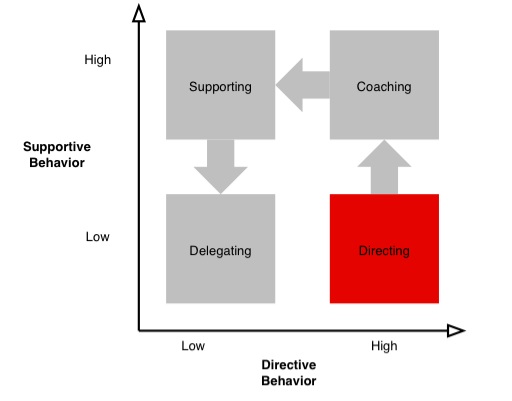
Directing
(copied from http://www.business-leadership-qualities.com/situationalleadership-d.html) In this phase, Directing, the follower is new to a task or new to a job.
The follower needs the task or job spelled out with clear direction. The follower needs to know:
- Desired outcome(s)
- Measures of success
- Specific process in place
- Resources for answers
- Therefore, at this point the leader directs.
Effective management at this point also requires the leader to interact with the follower and understand how quickly he or she gets it and when to move on. The leader need also be alert as to when to come back to this phase if either the leader or follower miscalulated understanding or ability.
Leadership Tips:
Given clear direction is a skill not every manager possesses. Here are things to keep in mind when giving directions:
- Give the overarching goal of the assignment first, then the steps to reach the goal. "The purpose of this report is to track project milestones. Tracking milestones gives us data to adjust our course or realign resources."
- Use short declarative sentences. "Reports are due on the 15th of every month."
- 5 - 7 chunks of data are all people can process well. If the assignment has more bits of data, group the bits
- Ask "What questions do you have?" rather than "Do you have any questions?" This lets the follower know you expect to get clarifying questions.
