Price Decisions in the Marketing Mix
Jump to navigation
Jump to search
Some examples of pricing decisions to be made include:
- Pricing strategy (skim, penetration, etc.)
- Suggested retail price
- Volume discounts and wholesale pricing
- Cash and early payment discounts
- Seasonal pricing
- Bundling
- Price flexibility
- Price discrimination
Frequent mistakes are determining prices Mark-up pricing and Competitive match pricing.
Which price maximizes long-term profits?
- Customer perceived benefits and price elasticity
- Competition (now and later)
- Business model
- Psychological effect
- Segmentation and positioning
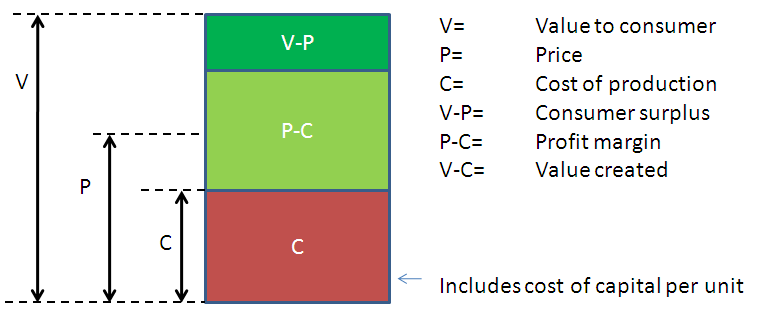
Value creation per unit looks like this:
Tests to determine price elasticity:
| Method | Advantages | Disadvantages |
|---|---|---|
| Price experiments | * Fast * Low risk * Many variants can be tested |
* External validity (transfer?) * Internal validity (too strong simplification |
| Classic market tests | * Realistics * Allows for good predictions |
* Reaction to heterogeneous prices? * Positioning jeopardized? * High cost / time |
| Tests over the internet | * Realistic * Very fast * Limited cost and time |
* Reaction to heterogenous prices? * "Unfair"? (Amazon) * Long range effects? * Not suitable for all distribution channel |
