Difference between revisions of "Technology life cycle"
Jump to navigation
Jump to search
(Replaced content with "Technology life cycle Category:mbi Category:Model Category:Term") Tag: Replaced |
|||
| Line 1: | Line 1: | ||
| − | + | <html> | |
| + | <img src="/static/files/MBI/Module%205/technologylifecycle.png" width = 400 /> | ||
| + | </html> | ||
| + | |||
| + | # Fluid | ||
| + | ## In the fluid phase there is a great deal of product and [[Market uncertainty|Market uncertainty]]. | ||
| + | ## Firms are not quite sure what should go into the product. | ||
| + | ## Customers too may not know what they want in the product. | ||
| + | ## There is competition between the new and old technologies as well as between different designs using the new technology. | ||
| + | ## Product quality is low | ||
| + | ## Cost and prices are high, economies of scale and learning have yet to set in. | ||
| + | ## Market penetration is low and customers are largely lead users | ||
| + | # Growth or Transitional | ||
| + | ## The transitional phase sets in when some standardization of components, market needs, and product design features takes place | ||
| + | ## A standard or common framework for offering products or services emerges signaling a substantial reduction in uncertainty, experimentation, and major changes. | ||
| + | ## The customer base increases from lead and high-income users to mass market during the growth phase. | ||
| + | ## Many firms find out that they do not have what it takes to compete | ||
| + | ## The number of entries decreases drastically while the number of exits increases tremendously. | ||
| + | # Stable | ||
| + | ## In the stable phase (or mature phase), products built around the common framework or standard proliferate. | ||
| + | ## Products are highly defined with differences fewer than similarities between competing products. | ||
| + | ## Demand growth slows considerably with most output earmarked to satisfy replacement needs. | ||
| + | ## The total number of firms in each industry decreases considerably from the peak of the growth phase. | ||
| + | ## In this phase, a firm’s strategies focus on defending its position and watching out for the next technological change that could start the life cycle over again. | ||
[[Category:mbi]] | [[Category:mbi]] | ||
Latest revision as of 20:04, 27 August 2020
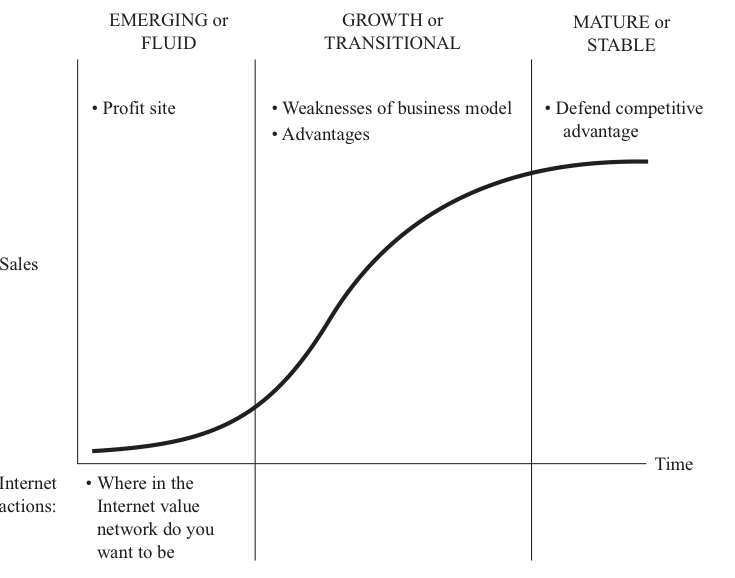
- Fluid
- In the fluid phase there is a great deal of product and Market uncertainty.
- Firms are not quite sure what should go into the product.
- Customers too may not know what they want in the product.
- There is competition between the new and old technologies as well as between different designs using the new technology.
- Product quality is low
- Cost and prices are high, economies of scale and learning have yet to set in.
- Market penetration is low and customers are largely lead users
- Growth or Transitional
- The transitional phase sets in when some standardization of components, market needs, and product design features takes place
- A standard or common framework for offering products or services emerges signaling a substantial reduction in uncertainty, experimentation, and major changes.
- The customer base increases from lead and high-income users to mass market during the growth phase.
- Many firms find out that they do not have what it takes to compete
- The number of entries decreases drastically while the number of exits increases tremendously.
- Stable
- In the stable phase (or mature phase), products built around the common framework or standard proliferate.
- Products are highly defined with differences fewer than similarities between competing products.
- Demand growth slows considerably with most output earmarked to satisfy replacement needs.
- The total number of firms in each industry decreases considerably from the peak of the growth phase.
- In this phase, a firm’s strategies focus on defending its position and watching out for the next technological change that could start the life cycle over again.
