Difference between revisions of "Option basics"
| Line 1: | Line 1: | ||
| − | Option | + | Credits for: http://people.stern.nyu.edu/adamodar/pdfiles/eqnotes/optionbasics.pdf but download-able locally [[http://files.dirkjanswagerman.nl/MBI/Module%2013/optionbasics.pdf|here]] |
| + | |||
| + | =Call options= | ||
| + | {{:Call options}} | ||
| + | |||
| + | =Put options= | ||
| + | {{:Put options}} | ||
| + | |||
| + | =Fundamental relation between call and put= | ||
| + | {{:Fundamental relation between call and put}} | ||
| + | |||
| + | =Determinants of option value= | ||
| + | {{:Determinants of option value}} | ||
| + | |||
| + | =American versus European options= | ||
| + | {{:American versus European options}} | ||
| + | |||
| + | =Summary of the Determinants of Option Value= | ||
| + | {{:Summary of the Determinants of Option Value}} | ||
[[Category:finance]] | [[Category:finance]] | ||
Latest revision as of 19:25, 27 August 2020
Credits for: http://people.stern.nyu.edu/adamodar/pdfiles/eqnotes/optionbasics.pdf but download-able locally [[1]]
Contents
Call options
A call option is the 'right but not the obligation to acquire an Asset by paying a certain sum of money on or before a certain time.
- European calls are only exercisable at expiration.
- An American call may be exercised at any time prior to expiration.
As a consequence, an American call must be at least as valuable as on otherwise identical European call.
Put options
A put option gives the buyer of the option the right to sell the underlying asset at a fixed price at any time prior to the expiration date of the option. The buyer pays a price for this right.
At expiration,
- If the value of the underlying asset (S) < Strike Price(K)
- -> Buyer makes the difference: K-S
- If the value of the underlying asset (S) > Strike Price (K)
- -> Buyer does not exercise
More generally,
- The value of a put decreases as the value of the underlying asset increases
- The value of a put increases as the value of the underlying asset decreases
A Pay-off Diagram for a buyer of put option looks like this: you start out with a loss and gain profit if the actual share price becomes lower than the strikeprice. Buying a put option buys you protection against lower stock prices.
javascript:;
<script>
var board = JXG.JSXGraph.initBoard('jxgbox3', {boundingbox: [-40, 150, 300, -150], keepaspectratio:true, axis:true});
 var strikepriceslider = board.create('slider', [[0,0],[300,0], [0.0,100, 300]], {name:'strikeprice'}, {withLabel: false});
 var putpriceslider = board.create('slider', [[0,0],[0,-300], [0.0,-100, -300]], {name:'callprice write'}, {withLabel: false});
var strikepriceline= board.create('line', [[function(){return strikepriceslider.X()}, function(){return -150}],[function(){return strikepriceslider.X()},function (){return 200}]],{'strokeColor':'red', 'dash':'true'});
 var writingputoptionarrow1 = board.create('arrow', [[function(){return strikepriceslider.X()+200}, function(){return putpriceslider.Y()}],[function(){return strikepriceslider.X()},function (){return putpriceslider.Y()}]],{'strokeColor':'yellow'});
 var writingoptionarrow2 = board.create('arrow', [[function(){return strikepriceslider.X()}, function(){return putpriceslider.Y()}],[function(){return strikepriceslider.X()-200},function (){return putpriceslider.Y()+200}]],{'strokeColor':'yellow'});
</script>
A Pay-off Diagram for a seller of put option ('writing' a put') looks like this. In the interactive diagram below, the purple line represents the put for the seller:
See also: Call options
Fundamental relation between call and put
In the picture below you can see a fundamental relation between a call and a put:
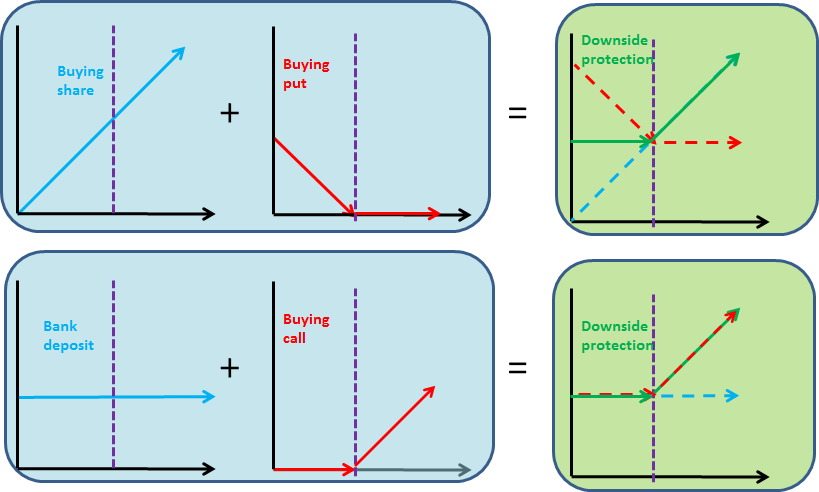
{{{ Buying share + Buying a put = Depositing the prevent value of the exercise price in the bank + Buying a call }}}
In human language this means that:
- Buying a call and saving the money of the exercise price
Is the same as
- Buying a put and buying the share
Other forms of this relationship are: {{{ Value of the put = Value of the call + Present value of exercise price - share price }}}
Buying a put is identical to:
- Buy a call
- Invest present value of exercise price in safe asset
- Sell share
Determinants of option value
The following components determine the value of an option:
- Variables Relating to Underlying Asset
- Value of Underlying Asset
- as this value increases, the right to buy at a fixed price (calls) will become more valuable and the right to sell at a fixed price (puts) willbecome less valuable.
- Variance in that value
- as the variance increases, both calls and puts will become more valuable because all options have limited downside and depend upon price volatility for upside.
- Expected dividends on the asset
- Which are likely to reduce the price appreciation component of the asset, reducing the value of calls and increasing the value of puts.
- Value of Underlying Asset
- Variables Relating to Option
- Strike Price of Options; the right to buy (sell) at a fixed price becomes more (less) valuable at a lower price.
- Life of the Option; both calls and puts benefit from a longer life.
- Level of Interest Rates; as rates increase, the right to buy (sell) at a fixed price in the future becomes more (less) valuable.
American versus European options
An American option can be exercised at any time prior to its expiration, while a European option can be exercised only at expiration.
- The possibility of early exercise makes American options more valuable than otherwise similar European options.
- However, in most cases, the time premium associated with the remaining life of an option makes early exercise sub-optimal.
- While early exercise is generally not optimal, there are two exceptions:
- One is where the underlying asset pays large dividends, thus reducing the value of the asset, and of call options on it. In these cases, call options may be exercised just before an ex-dividend date, if the time premium on the options is less than the expected decline in asset value.
- The other is when an investor holds both the underlying asset and deep in the money puts on that asset, at a time when interest rates are high.
The time premium on the put may be less than the potential gain from exercising the put early and earning interest on the exercise price.
Summary of the Determinants of Option Value
The table belows gives a Summary of the Determinants of Option Value:
| Factor | Call Value | Put Value |
|---|---|---|
| Increase in Stock Price | Increases | Decreases |
| Increase in Strike Price | Decreases | Increases |
| Increase in variance of underlying asset | Increases | Increases |
| Increase in time to expiration | Increases | Increases |
| Increase in interest rates | Increases | Decreases |
| Increase in dividends paid | Decreases | Increases |
