Difference between revisions of "Price Decisions in the Marketing Mix"
Jump to navigation
Jump to search
(Replaced content with "Price Decisions in the Marketing Mix Category:mbi Category:Term") Tag: Replaced |
|||
| Line 1: | Line 1: | ||
| − | Price | + | Some examples of pricing decisions to be made include: |
| + | * Pricing strategy (skim, penetration, etc.) | ||
| + | * Suggested retail price | ||
| + | * Volume discounts and wholesale pricing | ||
| + | * Cash and early payment discounts | ||
| + | * Seasonal pricing | ||
| + | * Bundling | ||
| + | * Price flexibility | ||
| + | * Price discrimination | ||
| + | |||
| + | |||
| + | |||
| + | <html><img src = ""/static/files/MBI/Module%206/pricingrange.PNG" width="600"/></html> | ||
| + | |||
| + | |||
| + | |||
| + | Frequent mistakes are determining prices [[Mark-up pricing|Mark-up pricing]] and [[Competitive match pricing|Competitive match pricing]]. | ||
| + | |||
| + | Which price maximizes long-term profits? | ||
| + | * Customer perceived benefits and price elasticity | ||
| + | * Competition (now and later) | ||
| + | * Business model | ||
| + | * Psychological effect | ||
| + | * Segmentation and positioning | ||
| + | |||
| + | Value creation per unit looks like this: | ||
| + | <html> | ||
| + | <img src="/static/files/MBI/Module%206/ValueCreation.PNG" width=400> | ||
| + | </html> | ||
| + | |||
| + | Tests to determine price elasticity: | ||
| + | {| class="wikitable" | ||
| + | !Method | ||
| + | !Advantages | ||
| + | !Disadvantages | ||
| + | |- | ||
| + | |Price experiments | ||
| + | |* Fast<br>* Low risk <br>* Many variants can be tested | ||
| + | |* External validity (transfer?) <br>* Internal validity (too strong simplification | ||
| + | |- | ||
| + | |Classic market tests | ||
| + | |* Realistics <br>* Allows for good predictions | ||
| + | |* Reaction to heterogeneous prices? <br> * Positioning jeopardized? <br>* High cost / time | ||
| + | |- | ||
| + | |Tests over the internet | ||
| + | |* Realistic <br>* Very fast <br>* Limited cost and time | ||
| + | |* Reaction to heterogenous prices? <br>* "Unfair"? (Amazon) <br>* Long range effects? <br> * Not suitable for all distribution channel | ||
| + | |- | ||
| + | |}Part of [[Marketing mix (Four P's of marketing)|Marketing mix (Four P's of marketing)]] | ||
[[Category:mbi]] | [[Category:mbi]] | ||
[[Category:Term]] | [[Category:Term]] | ||
Latest revision as of 20:01, 27 August 2020
Some examples of pricing decisions to be made include:
- Pricing strategy (skim, penetration, etc.)
- Suggested retail price
- Volume discounts and wholesale pricing
- Cash and early payment discounts
- Seasonal pricing
- Bundling
- Price flexibility
- Price discrimination
Frequent mistakes are determining prices Mark-up pricing and Competitive match pricing.
Which price maximizes long-term profits?
- Customer perceived benefits and price elasticity
- Competition (now and later)
- Business model
- Psychological effect
- Segmentation and positioning
Value creation per unit looks like this:
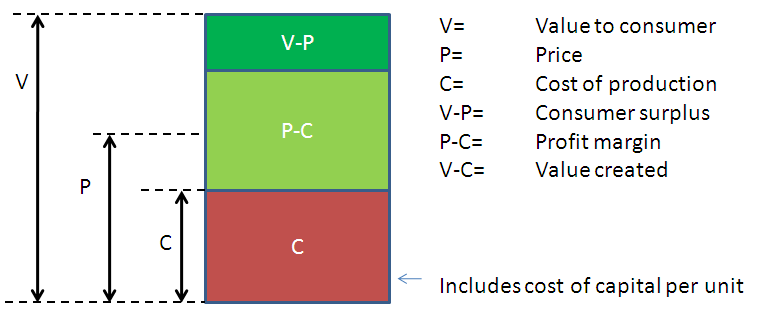
Tests to determine price elasticity:
| Method | Advantages | Disadvantages |
|---|---|---|
| Price experiments | * Fast * Low risk * Many variants can be tested |
* External validity (transfer?) * Internal validity (too strong simplification |
| Classic market tests | * Realistics * Allows for good predictions |
* Reaction to heterogeneous prices? * Positioning jeopardized? * High cost / time |
| Tests over the internet | * Realistic * Very fast * Limited cost and time |
* Reaction to heterogenous prices? * "Unfair"? (Amazon) * Long range effects? * Not suitable for all distribution channel |
