Difference between revisions of "Dot Voting"
(Created page with "=Object of play= In any good brainstorming session, there will come a time when there are too many good ideas, too many concepts, and too many possibilities to proceed. When t...") |
|
| (One intermediate revision by the same user not shown) | |
(No difference)
| |
Latest revision as of 19:26, 27 August 2020
Object of play
In any good brainstorming session, there will come a time when there are too many good ideas, too many concepts, and too many possibilities to proceed. When this time has come, dot voting is one of the simplest ways to prioritize and converge upon an agreed solution.
Number of players
At least 3 participants; in larger groups, tallying votes will be more time-consuming
Duration of play
Short
How to play
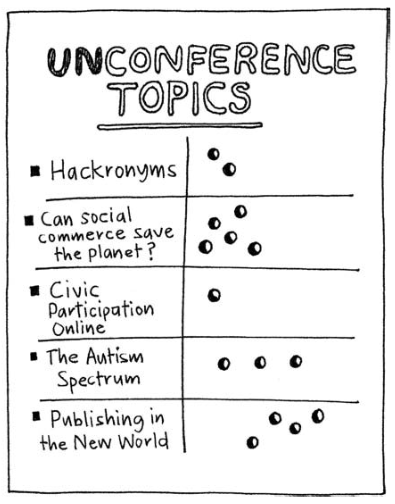
First, the group needs a set of things to vote on! Tis may be something they have just developed, such as a wall of sticky notes, or it may be a fip-chart list that captures the ideas in one place. Ask the group to cast their votes by placing a dot next to the items they feel the most strongly about. Tey may use stickers or markers to do this. As a rule of thumb, giving each participant five votes to cast works well.
Participants cast their votes all at once and they may vote more than once for a single item if they feel strongly about it. Once all the votes are cast, tally them, and if necessary make a list of the items by their new rank. This prioritized list becomes the subject of discussion and decision making. In some cases, it may be useful to refect on ideas that didn’t receive votes to verify that they haven’t been lef behind without cause.
Strategy
Tis technique is used to collaboratively prioritize any set of items. It could be used to hone a list of features, to agree on discussion topics, or to choose among strategies and concepts. Giving participants five votes is enough to be meaningful while still asking for individual prioritization; however, this is not a hard rule.
The original source of the Dot Voting game is unknown.
From the book: Gamestorming - A Playbook for innovators, Rulebreakers and Changemakers
