Difference between revisions of "Protect against imitation"
Jump to navigation
Jump to search
(Replaced content with "Protect against imitation Category:mbi Category:Term") Tag: Replaced |
|||
| Line 1: | Line 1: | ||
| − | + | Mechanisms to protect against imitation are: | |
| + | {| class="wikitable" | ||
| + | !'''Imitator''' | ||
| + | !'''Incumbent''' | ||
| + | |- | ||
| + | !Requirements for successful imitation | ||
| + | !Barriers against successful imitation | ||
| + | |- | ||
| + | |1) Must be able to identify competitive superiority | ||
| + | |* Withhold information about profitability<br>* Forgo short-term profits for long-term success | ||
| + | |- | ||
| + | |2) Must be willing to imitate | ||
| + | |* Deterrence (afschrikking, koude oorlog): signal promise to retaliation<br>* Make commitments to make threat credible<br>* Pre-emption: exploit all available investments opportunities/secure access to resources | ||
| + | |- | ||
| + | |3) Must be able to understand sources of competitive advantage | ||
| + | |* Tacit knowledge: rely on skills, processes or culture/resources that are implicit<br>* Causal ambiguity: rely on complex multidimensional mix of sources | ||
| + | |- | ||
| + | |4) Must be able to build / acquire necessary resources | ||
| + | |* Base differentiation on resoureces that are rare/immobile/contracted<br>* Exploit time tags | ||
| + | |- | ||
| + | |}Companies can find themselves in | ||
| + | # Sustaining circumstances | ||
| + | ## Incremental innovations | ||
| + | ## Higher margins by selling better products to the most demanding customers | ||
| + | # Disruptive circumstances | ||
| + | ## In contrast to sustaining innovations, disruptive innovations are not focused on bringing better products to existing high end customers | ||
| + | ## Instead, they usually tend to be significantly worse in the original performance dimensions | ||
| + | ## But they excel in other benefits such as simplicity, convenience and most importantly, a lower price | ||
| + | <html> | ||
| + | <img src="/static/files/MBI/Module%208/disruptiveinnovations.PNG" width=500> | ||
| + | </html> | ||
| + | |||
| + | Part of: [[M8-S2 - Reading - Strategies for E-Business - Chapter 6 - Sustaining Competitive Advantage|M8-S2 - Reading - Strategies for E-Business - Chapter 6 - Sustaining Competitive Advantage]] | ||
[[Category:mbi]] | [[Category:mbi]] | ||
[[Category:Term]] | [[Category:Term]] | ||
Latest revision as of 20:02, 27 August 2020
Mechanisms to protect against imitation are:
| Imitator | Incumbent |
|---|---|
| Requirements for successful imitation | Barriers against successful imitation |
| 1) Must be able to identify competitive superiority | * Withhold information about profitability * Forgo short-term profits for long-term success |
| 2) Must be willing to imitate | * Deterrence (afschrikking, koude oorlog): signal promise to retaliation * Make commitments to make threat credible * Pre-emption: exploit all available investments opportunities/secure access to resources |
| 3) Must be able to understand sources of competitive advantage | * Tacit knowledge: rely on skills, processes or culture/resources that are implicit * Causal ambiguity: rely on complex multidimensional mix of sources |
| 4) Must be able to build / acquire necessary resources | * Base differentiation on resoureces that are rare/immobile/contracted * Exploit time tags |
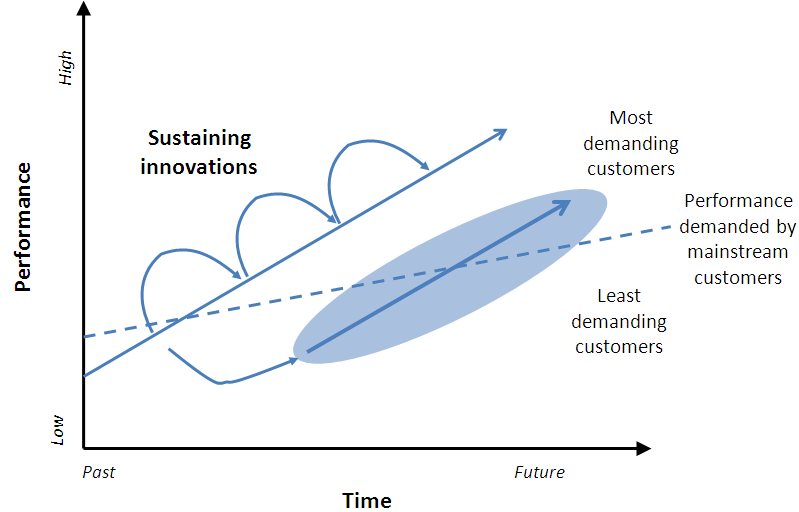
Companies can find themselves in
- Sustaining circumstances
- Incremental innovations
- Higher margins by selling better products to the most demanding customers
- Disruptive circumstances
- In contrast to sustaining innovations, disruptive innovations are not focused on bringing better products to existing high end customers
- Instead, they usually tend to be significantly worse in the original performance dimensions
- But they excel in other benefits such as simplicity, convenience and most importantly, a lower price
Part of: M8-S2 - Reading - Strategies for E-Business - Chapter 6 - Sustaining Competitive Advantage
