Difference between revisions of "NPV q"
Jump to navigation
Jump to search
(Replaced content with "NPV_q Category:finance Category:Capital projects as real options") Tag: Replaced |
|||
| Line 1: | Line 1: | ||
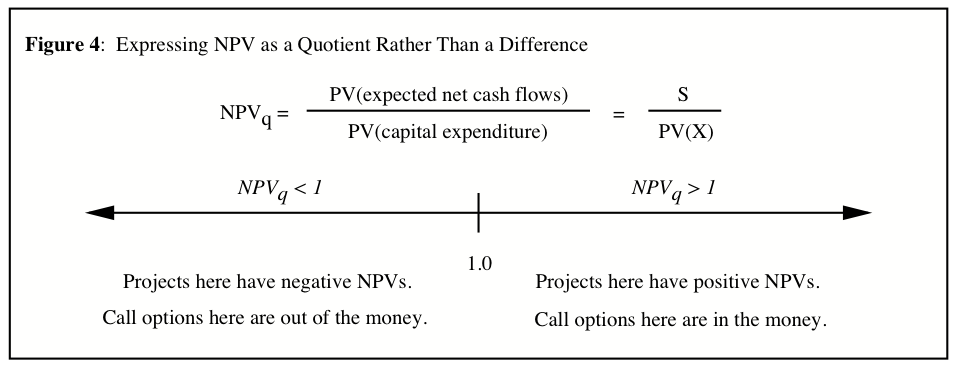
| − | + | The [[NPV|NPV]] can also be expressed as a quotient rather than a difference. Define | |
| + | <math>\text{Net Present Value (NPV)}_q = \frac{\text{PV (expected cash flows)}}{\text{PV(capital expenditures)}}</math> | ||
| + | or | ||
| + | <math>\text{NPV}_q</math> = <math>\frac{S}{PV(X)}</math> | ||
| + | |||
| + | Using this way of expressing the NPV the rule becomes if <math>\text{NPV}_q</math> >1 then invest, if <math>\text{NPV}_q</math> < 1 then don't invest. | ||
| + | |||
| + | <math>\text{NPV}_q</math> is used to determine if a call option should be exercised '''''at expiration'''''. By adding this condition <math>\text{NPV}_q</math> combines four of five determinants of option value (see [[Options|Options]]), The stock price <math>S</math>, the expenditure costs <math>X</math>, the [[Risk free rate of return|Risk free rate of return]] (part of the denominator to discount the costs) and t. | ||
| + | |||
| + | |||
| + | |||
| + | <html><img src = "/static/files/MBI/Module%2013/npvq.png" width="800"/></html> | ||
| + | |||
| + | |||
| + | |||
[[Category:finance]] | [[Category:finance]] | ||
[[Category:Capital projects as real options]] | [[Category:Capital projects as real options]] | ||
Latest revision as of 19:25, 27 August 2020
The NPV can also be expressed as a quotient rather than a difference. Define or =


Using this way of expressing the NPV the rule becomes if >1 then invest, if < 1 then don't invest.
is used to determine if a call option should be exercised at expiration. By adding this condition combines four of five determinants of option value (see Options), The stock price , the expenditure costs , the Risk free rate of return (part of the denominator to discount the costs) and t.