Difference between revisions of "The Strategy and Tactics of pricing"
(Created page with "Author: Thomas Nagle <html> <iframe src="http://rcm.amazon.com/e/cm?lt1=_blank&bc1=000000&IS2=1&npa=1&bg1=FFFFFF&fc1=000000&lc1=0000FF&t=httptiddlyweb-20&o=1&p=8&l=as1&m=amazo...") |
|||
| (One intermediate revision by the same user not shown) | |||
| Line 1: | Line 1: | ||
Author: Thomas Nagle | Author: Thomas Nagle | ||
| + | Amazon link: | ||
<html> | <html> | ||
| − | < | + | <a href="https://www.amazon.com/dp/0136106811">The Strategy and Tactics of pricing</a> |
</html> | </html> | ||
Latest revision as of 19:50, 27 August 2020
Author: Thomas Nagle Amazon link: The Strategy and Tactics of pricing
Contents
Value Creation
Many companies do not understand how their products, services or customer relations create value for their customers. They are assuming that adding features or improving performance will result in a difference. Two types of value creations matter to customers:
- Economical or Monetary value
- Psychological value
Examples:
- Sales will be able to use a strong value proposition
- Marketing will benefit from understanding how value propositions differ across markets
- Product Development will benefit from knowing which features customers want to pay for.
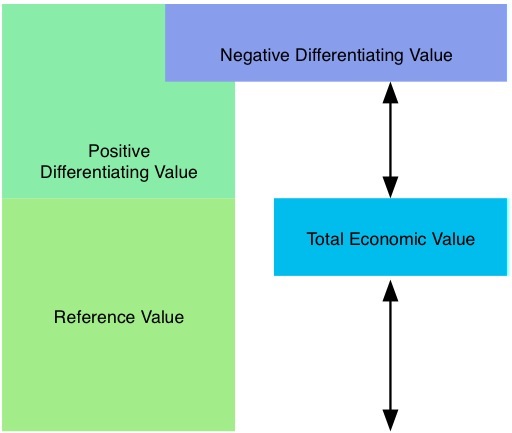
The term value refers to the overall satisfaction a customers enjoys from using a product or service offering. Economic value will be lower than perceived use value in most of the cases. The differentiating value is related to the positive discriminating value in economic or psychologic value with respect to the competitive offering.
Monetary value
Monetary value represents the total cost savings or income enhancements that a customer accrues as a result of purchasing a product or a service. This is the most important value for business to business sales.
Psychological value
Psychological value refers to the many ways a product or service can generate satisfaction for a user (see Universal Benefits))
Differentiating value
The differentiating value is the net benefit your product or service delivers to customers over a competitive offering. Differentiation can be negative (your offering is priced higher expensive) of positive (your offering is priced lower) with respect to a competitive baseline.
Total economic value
The total economic value is defined to be the price of the customers best alternative (reference value) plus whatever differentiates the offering from the competition.
Next Best Competitive Alternative
One of the most critical aspects driving customer choice and willingness to pay is the alternative offerings. The next best competitive alternative (NBCA). The NBCA, which is the price the competitor charges for the product or service, defines the reference value for an offering.
Methods to quantifying monetary or psychological value
Competitive reference prices
- Make sure prices are in terms known to your market segment (currency, physical unities)
- Polling the sales force
- Interviewing customers
Estimating monetary value
Ultimately the ability to appropriate monetary value is depending on the accuracy with which buyers perceive the generated value
- Estimate gain for economic value drivers
- Create list of economic value drivers for each segment
- Cost drivers
- Revenue drivers
- Create value driver algorithms for each driver
- Add up all items to come to the total monetary value
- Tip is to only add up the monetary value with respect to the next best competitive alternative
Example value drivers:
- Yield opportunity costs
- Yield labor savings
- Quality control labor savings
- Sample size opportunity costs
- Sample size labor savings
Estimating psychological value
The most widely used approach for this is Conjoint analysis In conjoint analysis the product or service is decomposed in features. Potential buyers are confronted with different features and asked which they prefer.
Pricing
There are no shortcuts to pricing. The total economic value of a differentiated product is proportional to its technical efficiency (e.g. 'x % better, faster' etc) only when buying more of the product has more benefits.
Value based market segmentation
A lot of companies 'segment their company along attributes that are not relevant to pricing decisions. Charging an arbitrarily segmented market the same price will underprice certain customers and overprice other customer leaving. A few points:
- Most segmentation criteria poorly reflect price sensitivity
- Even 'need based' segmentation criteria focus on those needs that are deemed important by the customer. They miss the criteria that would have the biggest operational impact on the customer and the sellers cost to serve those needs.
- In depth interviews will reveal why customers find certain benefits appealing.
Six steps to value based segmentation
Nagel et all recommend a six step value based segmentation strategy:
- Determine basic segmentation criteria
- Choose criteria that determine customers buying behaviors
- Obvious criteria (link to existing MBI ones)
- Enterprise firmographics (#employees, revenue, etc, geography)
- Outputs include sketch of basic needs, list of unmet needs, buying behaviors
- Check draft segmentation with sales people and managers.
- Identify discriminating value drivers
- Focus on purchasing behaviors
- Identify the drivers that differ most between segments and are homogenous within a segment
- What are the customers revenue and cost improving drivers?
- Determine your own operational constraints and advantages
- Look at your own strengths to serve the difference customers segments
- Consider Activity based costing to get a clear view on what each segment costs to serve
- Build a customer behavior spectrum mapping your true cost to serve each customer
- Look at thinks like need for service, time decide, frequency of buying etc.
- Create primary and secondary segments
- Dive a bit deeper in identifying axes of segmentation but no use going too far with this
- The primary segment should account for your companies capabilities as well as your customers need.
- The most important criterium is likely to be the most important differentiator among customers: the one with the most operational impact.
- Your secondary segmentation criterium will be the one for which the primary segment differs most
- Create detailed segment descriptions
- Make sure that everyone understands your segments very well
- This will help communication of your segmentation in the organization
- Develop segment metrics and Fences
- Fences are policies, rules, agreements that customers (sales...) need to follow
Price Structure
After segmenting the market and 'creating value' the next step is to identify a pricing structure to optimizes the company profitability both in volume and in margin. The challenge is that customers value offerings different in terms of willingness and ability to pay, different preference and different intended uses. Pricing strategies therefore need to be specific per market segment. Market segmentations are sometimes difficult too maintain as customers have an incentive to try to qualify for the criteria of the 'cheaper' segment. Also distributors can undermine your pricing strategy by buying from you at the lower price point but sell the item to a customer would actually belong to the higher priced segment.
Willingness to pay different prices in different segments justify different go to market strategy. The amount of segments depends on the following factors:
- Price offer configurations
- Price Metrics
- Price fences
Price offer configurations
Depending on how different segmentations value certain features and services, optimally configured offerings for each targeted segment can be created. There are multiple arguments in favor of bundling and against pricing each item separately:
- A single bundle reduces the cost of the transaction for both parties
- The cost of creating combinations of each offering increase with the variations allowed
- People are less sensitive to the cost of value added service when bundled
- Sellers can earn more profit with bundles that are highly appealing to certain customer segments but less to others.
- The following table illustrates this. Music lovers value 'top artist' and 'new performers' the same. Entertainment seekers want to pay premium for the top artists but are not too keen on the new performers. Pricing a must see concert at 25 would leave out the entertainment seekers. Pricing a must see at at 25 would get both groups in by a lot of potential value is left to the table. Both groups would be prepared to pay
- Bundling can also have advantages when a certain customer segment has a high price sensitivity to one of the features of the offered product or service.


Bundling in 'negative' features can also be profitable: an example of this is the mandatory 'Saturday night' stay that keep out most business customers but attract pleasure travelers for the discount.
If bundling includes variable cost products or services for free it can have a negative effect on profitability. This problem is most prominent when there is a great difference in consumption for each customer and therefore the costs of certain customers can be very high. Price metrics Price fences
Difference in value of an offering
The following are causes in the perceive value of an offering:
- Differences in valuation of the features offered
- Differences in valuation of the services offered
Examples of bundling and unbundling features
- Airlines offering seats cheaper depending on the feature to cancel the flight or change routes
