Difference between revisions of "Profit formula"
Jump to navigation
Jump to search
(Created page with "A profit formula is the blue print that defines how the company creates value for itself. The profit formula is tightly coupled to the Customer Value Proposition|Customer Va...") |
|||
| (4 intermediate revisions by the same user not shown) | |||
| Line 8: | Line 8: | ||
</html> | </html> | ||
Part of [[M8-S2 - Reading - Mark W. Johnson, Clayton Christensen, and Henning Kagermann, Reinventing your business model|M8-S2 - Reading - Mark W. Johnson, Clayton Christensen, and Henning Kagermann, Reinventing your business model]] | Part of [[M8-S2 - Reading - Mark W. Johnson, Clayton Christensen, and Henning Kagermann, Reinventing your business model|M8-S2 - Reading - Mark W. Johnson, Clayton Christensen, and Henning Kagermann, Reinventing your business model]] | ||
| − | [[Category: | + | [[Category:mbi]] |
| − | |||
| − | |||
[[Category:Term]] | [[Category:Term]] | ||
Latest revision as of 20:08, 27 August 2020
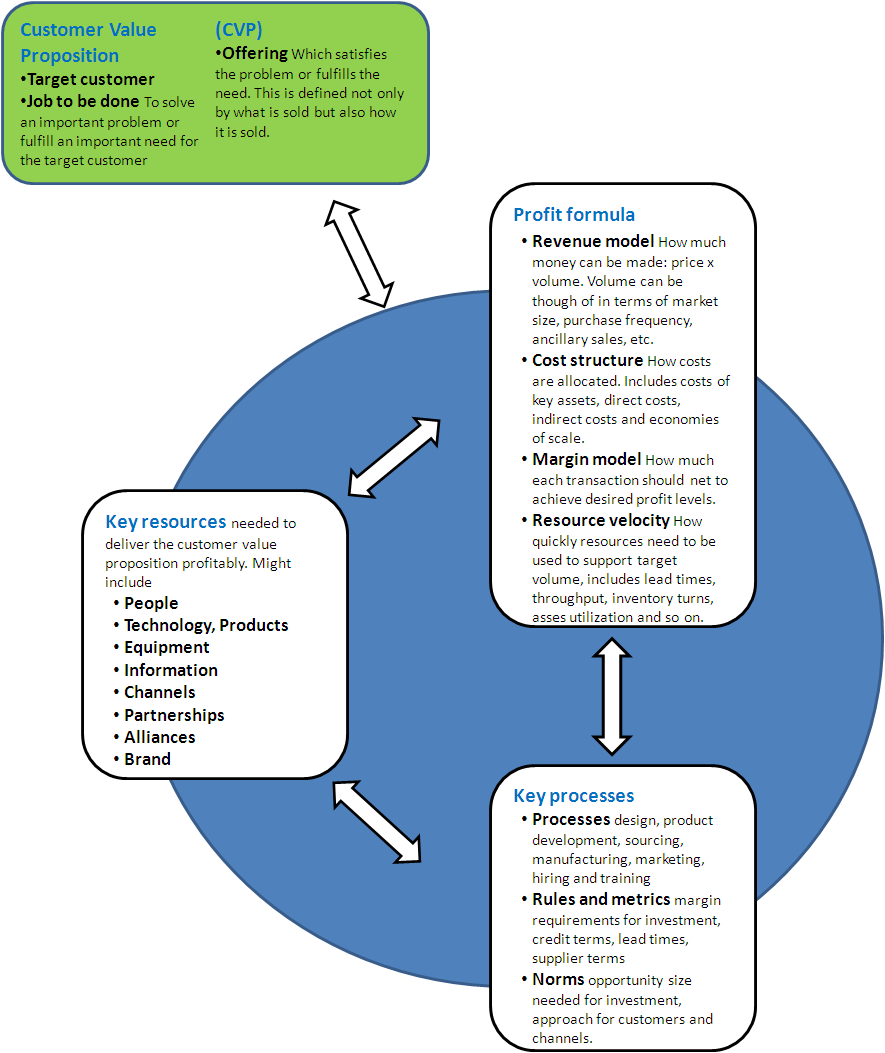
A profit formula is the blue print that defines how the company creates value for itself. The profit formula is tightly coupled to the Customer Value Proposition and helps defining contraints on revenue, fixed costs, variable costs, etc.:
- Revenue model, price x volume
- Cost structure, direct & indirect costs: dominantly driven by the key resources in the business model
- Margin model, given the expected volume and cost structure, the contribution needed from each transaction to reach profit
- Resource velocity, how fast we need to turn over inventory, fixed assets and other assets. How well do we need to utilize resources to support expected volume.
 Part of
