Difference between revisions of "Normal distribution"
(Created page with "The normal distribution is the most widely used statistical distribution and is defined by its mean <math> \mu </math> and standard variance <math> \sigma </math> <math>P(x)<...") |
|||
| (One intermediate revision by the same user not shown) | |||
| Line 23: | Line 23: | ||
The normal distribution can be used to approximate the binomial distribution, <math>np</math> is the mean and <math>\sqrt{np(1-p)}</math> is the standard deviation of a binomial distribution. Therefore Z can be written as: | The normal distribution can be used to approximate the binomial distribution, <math>np</math> is the mean and <math>\sqrt{np(1-p)}</math> is the standard deviation of a binomial distribution. Therefore Z can be written as: | ||
| − | Z = <math> | + | Z = <math>\frac{X=np}{\sqrt {np(1-p)}}</math> |
And the poison distribution: | And the poison distribution: | ||
| − | Z = <math> | + | Z = <math>\frac{X-\lambda}{\sqrt \lambda}</math> |
Example of the latter. If the average # of broken eggs is 50. What is the probability there will be more than 70 broken eggs? | Example of the latter. If the average # of broken eggs is 50. What is the probability there will be more than 70 broken eggs? | ||
Latest revision as of 20:01, 27 August 2020
The normal distribution is the most widely used statistical distribution and is defined by its mean and standard variance


= Failed to parse (syntax error): {\displaystyle \frac{1}} {{\sigma \sqrt {2\pi } }}e^{{{ - \left( {x - \mu } \right)^2 } \mathord{\left/ {\vphantom {{ - \left( {x - \mu } \right)^2 } {2\sigma ^2 }}} \right. } {2\sigma ^2 }}}

The standard normal distribution is scaled back to a mean of 0 and a standard deviation of 1:

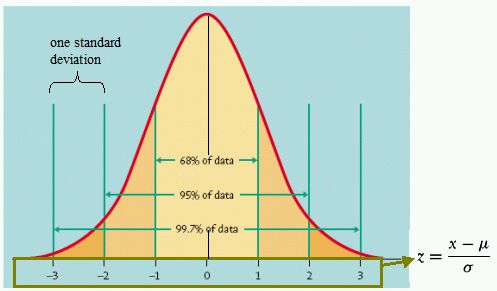
Useful properties of the normal distribution are:
- The total area under the standard normal distribution curve is 1.
- At Z=0 the total area under the curve is 0.5
- To measure the area between two Z-values you can subtract the z values (Look up in the Standard Normal Distribution Table) To find the probability of a value between 1 and 1.1 standard deviations above the mean you calculate:
{{{ Area above Z = 1 is 0.1587 Area above Z = 1.1 is 0.1357 }}} Therefore the area between Z=1 and Z=1.1 is 0.3413 - 0.3413 = 0.0230
- It is symmetric. The probability to be -Z away from the mean is equal to being away +Z.
The normal distribution can be used to approximate the binomial distribution, is the mean and is the standard deviation of a binomial distribution. Therefore Z can be written as: Z =


And the poison distribution: Z =

Example of the latter. If the average # of broken eggs is 50. What is the probability there will be more than 70 broken eggs?
Mean = = 50 Standard deviation= = 7.07107


The area requires is the area above X=70.5 so Z will be: Z = This makes the probability 1 - 0.5 - 0.4980 = 0.002

Part of: M7-Quantitative Decision Methods-S3 - Normal Distribution and confidence intervals
