Difference between revisions of "Decision Trees"
Jump to navigation
Jump to search
(Replaced content with "Decision Trees Category:mbi Category:Term") Tag: Replaced |
|||
| Line 1: | Line 1: | ||
| − | Decision | + | Decision support tool that uses a tree-like graph or model of decisions and their possible consequences, including chance event outcomes, resource costs, and utility. A decision tree combines the idea of a [[Probability tree|Probability tree]] with [[Expected value|Expected value]]. |
| + | |||
| + | A decision tree consists of 3 types of nodes: | ||
| + | 1. Decision nodes - commonly represented by squares | ||
| + | 2. Chance nodes - represented by circles | ||
| + | 3. End nodes - represented by triangles | ||
| + | |||
| + | |||
| + | |||
| + | <html><img src = "/static/files/MBI/Module%204/decisiontree.png" width="600"/></html> | ||
| + | |||
| + | |||
| + | |||
| + | Source: http://en.wikipedia.org/wiki/Decision_tree | ||
[[Category:mbi]] | [[Category:mbi]] | ||
[[Category:Term]] | [[Category:Term]] | ||
Latest revision as of 19:54, 27 August 2020
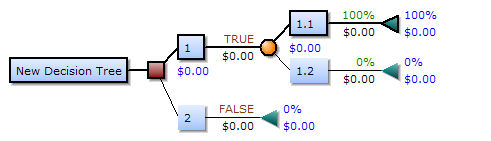
Decision support tool that uses a tree-like graph or model of decisions and their possible consequences, including chance event outcomes, resource costs, and utility. A decision tree combines the idea of a Probability tree with Expected value.
A decision tree consists of 3 types of nodes: 1. Decision nodes - commonly represented by squares 2. Chance nodes - represented by circles 3. End nodes - represented by triangles