Difference between revisions of "Crossing the chasm"
(Replaced content with "Crossing the chasm Category:mbi Category:Model") Tag: Replaced |
|||
| Line 1: | Line 1: | ||
| − | Crossing the chasm | + | When confronted with new technology (say "electric car"), people vary in when they 'jump on the wagon'. Consumers can be qualified along to how fast they are eager to try something new: |
| + | <html> | ||
| + | <img src="/static/files/MBI/Module%206/Technology-Adoption-Lifecycle.png" width="600" /> | ||
| + | </html> | ||
| + | {| class="wikitable" | ||
| + | |[[Innovator|Innovator]] | ||
| + | |"I would like to try it first" | ||
| + | |- | ||
| + | |[[Early Adopter|Early Adopter]] | ||
| + | |"I would like to try soon" | ||
| + | |- | ||
| + | |[[Early Majority|Early Majority]] | ||
| + | |"When i have seen electric cars prove themselves" | ||
| + | |- | ||
| + | |[[Late Majority|Late Majority]] | ||
| + | |"Not until most people made the switch and it becomes inconvenient to drive a gasoline car" | ||
| + | |- | ||
| + | |[[Laggard|Laggard]] | ||
| + | |"Not until hell freezes over" | ||
| + | |- | ||
| + | |} | ||
| + | Moore discriminates between [[Discontinous innovations|Discontinous innovations]] (require people to change behavior, examples are new HD TV incompatible with todays standards) and [[Continuous innovations|Continuous innovations]] (do not require people to change behavior, more economic car, better teeth withener). Between these two ends of the spectrum, there is a continuem of more and less demanding innovations requiring change. | ||
| + | |||
| + | High tech companies are more frequently introducing change demanding innnovations and need a marketing model coping with this model of product introduction (original model create during research on the adoption of new strains of seed potatoes :-)) | ||
| + | |||
| + | The model simply states that to develop a high market you need to move from the left to the right and adjust your market strategy around it. Each group becomes a reference for endorsements for the next group. The model promisses a 'virtual monopoly': who gets their first and catches the wave can ride it to the end. | ||
| + | |||
| + | In the revised high marketing model each phase transition has a gap in between them, emphasizing that companies might miss the boat and loose market share to a compatitor. Two 'cracks' are considered most important: | ||
| + | |||
| + | * The gap between the early adopters and the early minority, the so called 'chasm'. | ||
| + | ** The key to this leap is to show that the technology enables a leap forward, something that was not possible before and has appeal to a non-technologist. | ||
| + | * The gap between the early majority and the late majority | ||
| + | ** The key to this leap is to demonstrate in addition that the technology is very easy to use. | ||
| + | ** The early majority wants to buy a ''productivity improvement''! They are looking for a way to minimize the discontinuity with the old ways. | ||
| + | |||
| + | Part of: [[M6-S2 - Reading - Crossing the chasm: marketing and selling high-tech products to mainstream customers|M6-S2 - Reading - Crossing the chasm: marketing and selling high-tech products to mainstream customers]] | ||
[[Category:mbi]] | [[Category:mbi]] | ||
[[Category:Model]] | [[Category:Model]] | ||
Latest revision as of 19:54, 27 August 2020
When confronted with new technology (say "electric car"), people vary in when they 'jump on the wagon'. Consumers can be qualified along to how fast they are eager to try something new:
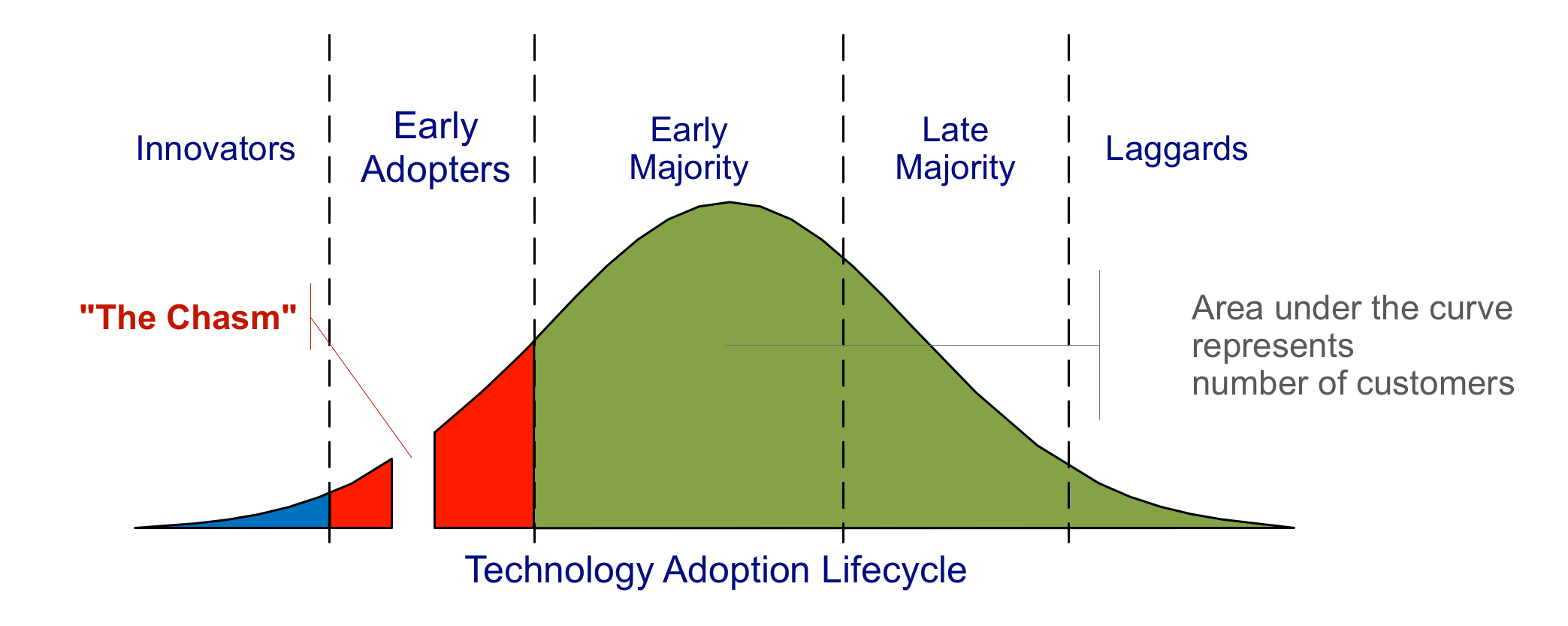
| Innovator | "I would like to try it first" |
| Early Adopter | "I would like to try soon" |
| Early Majority | "When i have seen electric cars prove themselves" |
| Late Majority | "Not until most people made the switch and it becomes inconvenient to drive a gasoline car" |
| Laggard | "Not until hell freezes over" |
Moore discriminates between Discontinous innovations (require people to change behavior, examples are new HD TV incompatible with todays standards) and Continuous innovations (do not require people to change behavior, more economic car, better teeth withener). Between these two ends of the spectrum, there is a continuem of more and less demanding innovations requiring change.
High tech companies are more frequently introducing change demanding innnovations and need a marketing model coping with this model of product introduction (original model create during research on the adoption of new strains of seed potatoes :-))
The model simply states that to develop a high market you need to move from the left to the right and adjust your market strategy around it. Each group becomes a reference for endorsements for the next group. The model promisses a 'virtual monopoly': who gets their first and catches the wave can ride it to the end.
In the revised high marketing model each phase transition has a gap in between them, emphasizing that companies might miss the boat and loose market share to a compatitor. Two 'cracks' are considered most important:
- The gap between the early adopters and the early minority, the so called 'chasm'.
- The key to this leap is to show that the technology enables a leap forward, something that was not possible before and has appeal to a non-technologist.
- The gap between the early majority and the late majority
- The key to this leap is to demonstrate in addition that the technology is very easy to use.
- The early majority wants to buy a productivity improvement! They are looking for a way to minimize the discontinuity with the old ways.
