Difference between revisions of "The Commodity Magnet"
Jump to navigation
Jump to search
| Line 1: | Line 1: | ||
| − | The | + | The concept of the ''commodity magnet'' synthesis the manner in which industry dynamics can create customer value and destroy company value. the key dimensions in the model are: |
| + | * Price | ||
| + | * Cost to serve | ||
| + | |||
| + | |||
| + | <html><img src = "/static/files/MBI/Module%2011/commoditymagnet.PNG" width="600"/></html> | ||
| + | |||
| + | |||
| + | * '''I''' When a company successfully innovates and markets a new offering it starts in the top right quadrant. Through its differentiation it can command a higher price. As the company is learning, it's costs of operation are also high. | ||
| + | * '''II''' A good way to enjoy pioneering advantages is to introduce the innovation to more customers (1) (a [[Product leadership strategy|Product leadership strategy]]) and becoming the brand leader. | ||
| + | * '''III''' As a good market attracts more competition (2) (requiring a [[Customer intimacy strategy|Customer intimacy strategy]] strategy), choice will be created for customers and prices will be forced down. | ||
| + | * '''IV''' When industry participants stop innovating and customers become more knowledgeable (3) (requiring a [[Operational efficiency strategy|Operational efficiency strategy]]), the customers stops comparing and starts demanding. They now occupy the driver seat and will degrade competition in the industry. | ||
| + | |||
[[Category:marketing]] | [[Category:marketing]] | ||
Latest revision as of 19:50, 27 August 2020
The concept of the commodity magnet synthesis the manner in which industry dynamics can create customer value and destroy company value. the key dimensions in the model are:
- Price
- Cost to serve
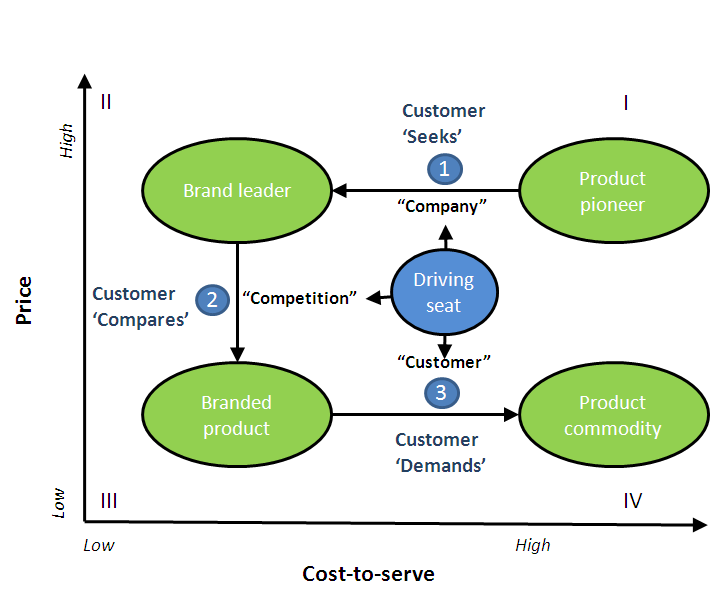
- I When a company successfully innovates and markets a new offering it starts in the top right quadrant. Through its differentiation it can command a higher price. As the company is learning, it's costs of operation are also high.
- II A good way to enjoy pioneering advantages is to introduce the innovation to more customers (1) (a Product leadership strategy) and becoming the brand leader.
- III As a good market attracts more competition (2) (requiring a Customer intimacy strategy strategy), choice will be created for customers and prices will be forced down.
- IV When industry participants stop innovating and customers become more knowledgeable (3) (requiring a Operational efficiency strategy), the customers stops comparing and starts demanding. They now occupy the driver seat and will degrade competition in the industry.
