Difference between revisions of "Fishbowl"
(Replaced content with "Fishbowl Category:games Category:Game Category:Opening") Tag: Replaced |
|||
| Line 1: | Line 1: | ||
| − | Fishbowl | + | =Object of play= |
| + | Ofen during meetings we bring together stakeholders who aren’t familiar with each other’s perspectives or aren’t accustomed to listening to each other without ofering an immediate response. In some cases, stakeholders may even be meeting for the frst time. | ||
| + | In scenarios like these, it’s not surprising that it can be difcult for people to engage in a rich and meaningful conversation. Te Fishbowl game is an efective way to activate attention—to prime our natural listening and observing skills so that a more substantive conversation can take place. | ||
| + | =Number of players= | ||
| + | Medium to large groups | ||
| + | =Duration of play= | ||
| + | 40–45 minutes | ||
| + | =How to play= | ||
| + | # Before the meeting, think of a topic that could be served by a group discussion and write down questions associated with it. | ||
| + | # Find a room with a good amount of open space and clear out anything other than chairs. | ||
| + | # Create a handout similar to the following: | ||
| + | |||
| + | |||
| + | <html><img src = "Fishbowl.png" width="400"/></html> | ||
| + | |||
| + | |||
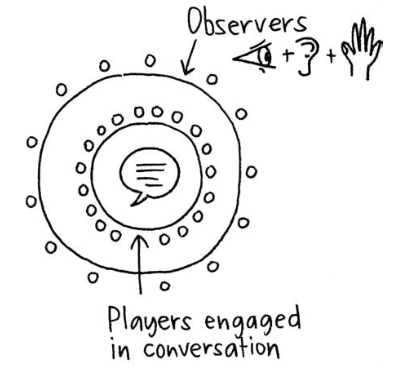
| + | 4. Arrange the chairs in two concentric circles in the room, as shown in the following fgure. The inner circle seats the players engaged in conversation; the outer circle seats the players acting as observers. | ||
| + | |||
| + | |||
| + | <html><img src = "/static/files/Softskills/Gamestorming/Fishbowl2.png" width="300"/></html> | ||
| + | |||
| + | |||
| + | 5. Introduce the game and assign “observer” or “player” status to each person. Give everyone a pen and a handout (but mention that the handout is used only in the observer role). Ask the participants to sit in the circle relative to their assigned role. | ||
| + | 6. Announce the topic of the game and ask the players to take 15 minutes to have a discussion around it. Use the questions you generated before the meeting to start the conversation and keep it moving. Make sure the players know that their responsibility is simply to converse in the circle. Make sure the observers know that their role is to pay close attention and to write on the handouts all discussion points and evidence that come out of the conversation. | ||
| + | 7. When 15 minutes are up, ask the group to switch seats and switch roles. Then start another 15-minute discussion on the same topic or a diferent one. | ||
| + | 8. Afer both conversations have completed, ask for volunteers to share the information they gathered and ask them to describe their experiences on the inner versus outer circle. | ||
| + | =Strategy= | ||
| + | People are well versed in having conversations; what most of us aren’t used to is listening, observing, and being accountable for our observations. The Fishbowl game, therefore, is about engaging skills that in many of us have become rusty. So, despite the fact that it may look as though the action happens in the players’ conversation, the action in this game happens in the outer circle, with the observers. As the group leader, be clear with the group that this is a listening and observing exercise. If there were a point system (and there is decidedly not), points would be awarded to those who most accurately logged the conversation that took place—not to those who made the most comments in the discussion. Talk to the group about their experience of being silent and paying attention. What was dificult about it? What was easy? How did it afect their perception of the topic and the other players? Use the Fishbowl exercise as a segue to a heightened five-and-take between stakeholders. | ||
| + | |||
| + | ''The Fishbowl game is based on ideas from the Facilitator’s Guide to Participatory DecisionMaking, by Sam Kaner et al.'' | ||
| + | |||
| + | From the book: [[Gamestorming - A Playbook for innovators, Rulebreakers and Changemakers|Gamestorming - A Playbook for innovators, Rulebreakers and Changemakers]] | ||
[[Category:games]] | [[Category:games]] | ||
Latest revision as of 19:27, 27 August 2020
Object of play
Ofen during meetings we bring together stakeholders who aren’t familiar with each other’s perspectives or aren’t accustomed to listening to each other without ofering an immediate response. In some cases, stakeholders may even be meeting for the frst time. In scenarios like these, it’s not surprising that it can be difcult for people to engage in a rich and meaningful conversation. Te Fishbowl game is an efective way to activate attention—to prime our natural listening and observing skills so that a more substantive conversation can take place.
Number of players
Medium to large groups
Duration of play
40–45 minutes
How to play
- Before the meeting, think of a topic that could be served by a group discussion and write down questions associated with it.
- Find a room with a good amount of open space and clear out anything other than chairs.
- Create a handout similar to the following:

4. Arrange the chairs in two concentric circles in the room, as shown in the following fgure. The inner circle seats the players engaged in conversation; the outer circle seats the players acting as observers.
5. Introduce the game and assign “observer” or “player” status to each person. Give everyone a pen and a handout (but mention that the handout is used only in the observer role). Ask the participants to sit in the circle relative to their assigned role.
6. Announce the topic of the game and ask the players to take 15 minutes to have a discussion around it. Use the questions you generated before the meeting to start the conversation and keep it moving. Make sure the players know that their responsibility is simply to converse in the circle. Make sure the observers know that their role is to pay close attention and to write on the handouts all discussion points and evidence that come out of the conversation.
7. When 15 minutes are up, ask the group to switch seats and switch roles. Then start another 15-minute discussion on the same topic or a diferent one.
8. Afer both conversations have completed, ask for volunteers to share the information they gathered and ask them to describe their experiences on the inner versus outer circle.
Strategy
People are well versed in having conversations; what most of us aren’t used to is listening, observing, and being accountable for our observations. The Fishbowl game, therefore, is about engaging skills that in many of us have become rusty. So, despite the fact that it may look as though the action happens in the players’ conversation, the action in this game happens in the outer circle, with the observers. As the group leader, be clear with the group that this is a listening and observing exercise. If there were a point system (and there is decidedly not), points would be awarded to those who most accurately logged the conversation that took place—not to those who made the most comments in the discussion. Talk to the group about their experience of being silent and paying attention. What was dificult about it? What was easy? How did it afect their perception of the topic and the other players? Use the Fishbowl exercise as a segue to a heightened five-and-take between stakeholders.
The Fishbowl game is based on ideas from the Facilitator’s Guide to Participatory DecisionMaking, by Sam Kaner et al.
From the book: Gamestorming - A Playbook for innovators, Rulebreakers and Changemakers
