Difference between revisions of "Value Based Management"
Jump to navigation
Jump to search
| Line 1: | Line 1: | ||
| − | Value Based Management | + | The basic assumption of Value Based Management is look only at [[Operational Cash Flow|Operational Cash Flow]] for evaluating the value generation capabilities of a firm. |
| + | |||
| + | {| class="wikitable" | ||
| + | !Value Based Management | ||
| + | !Traditional P&L | ||
| + | |- | ||
| + | |[[NOPAT|NOPAT]] stands for Net Operating Profits After Tax | ||
| + | |Sales Revenue - Full Costs of Sales (excl interest) | ||
| + | |- | ||
| + | |[[EBIAT|EBIAT]] | ||
| + | |- | ||
| + | |} | ||
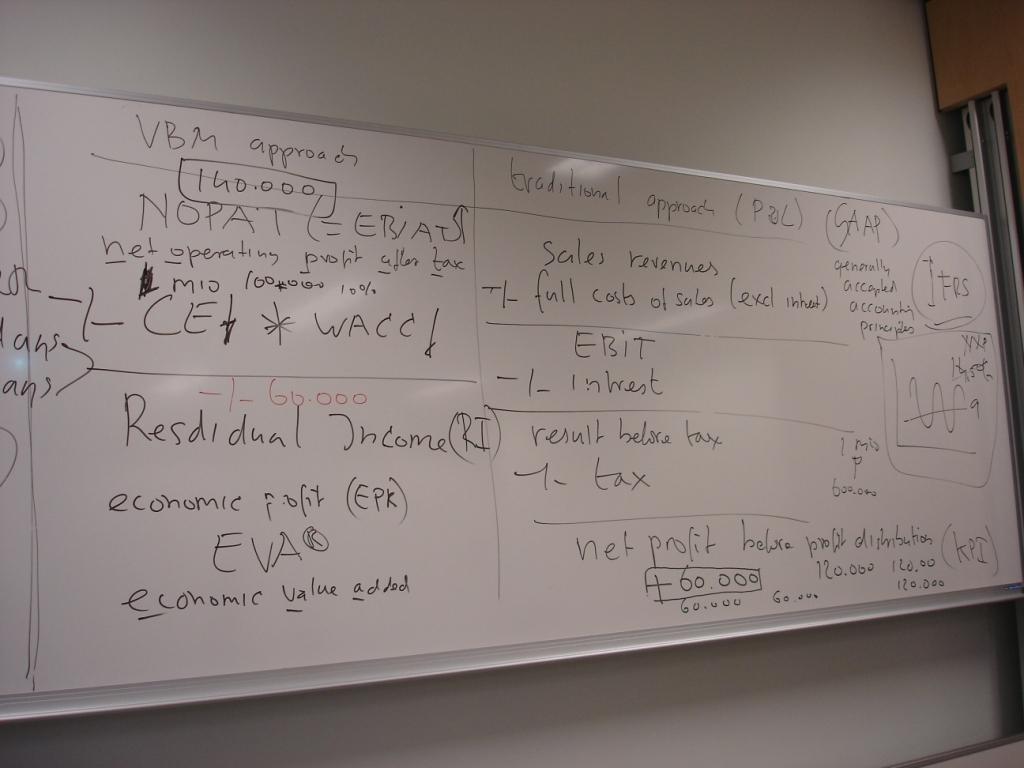
| + | This was the picture on the board during the [[M9-Accounting|M9-Accounting]] block: | ||
| + | <html> | ||
| + | <img src=/static/files/MBI/Module%209/DSC08469a.JPG width=500> | ||
| + | </html> | ||
[[Category:finance]] | [[Category:finance]] | ||
Latest revision as of 19:26, 27 August 2020
The basic assumption of Value Based Management is look only at Operational Cash Flow for evaluating the value generation capabilities of a firm.
| Value Based Management | Traditional P&L |
|---|---|
| NOPAT stands for Net Operating Profits After Tax | Sales Revenue - Full Costs of Sales (excl interest) |
| EBIAT |
This was the picture on the board during the M9-Accounting block: