Difference between revisions of "Hamada formula"
Jump to navigation
Jump to search
| Line 8: | Line 8: | ||
| − | <math> \text{Unlevered beta}</math> = <math>\frac{B^L}{1+(1-T_c)*\frac{D}{E}}</math> | + | <math> \text{Unlevered beta}</math> = <math>\huge \frac{B^L}{1+(1-T_c)*\frac{D}{E}}</math> |
Where: | Where: | ||
| Line 16: | Line 16: | ||
* <math>{T_c}</math> is the corporate tax rate. | * <math>{T_c}</math> is the corporate tax rate. | ||
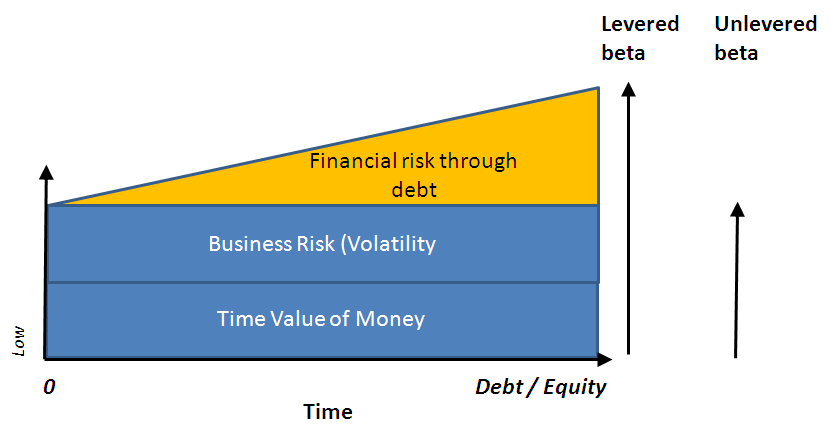
| − | == The point of the unlevered beta is to ''''remove'''' the debt risk from a publicly known company in a sector comparable to your own company ('unlever the beta') add your own debt risk and 'lever' the beta.== | + | ==+ The point of the unlevered beta is to ''''remove'''' the debt risk from a publicly known company in a sector comparable to your own company ('unlever the beta') add your own debt risk and 'lever' the beta.== |
Revision as of 18:16, 26 August 2020
Levered Beta is the beta that reflects a capital structure that does include debt. The Unlevered Beta is the Beta of a company without any debt. Unlevering a beta removes the financial effects from leverage.
= Failed to parse (unknown function "\huge"): {\displaystyle \huge \frac{B^L}{1+(1-T_c)*\frac{D}{E}}}

Where:
- is the levered, published beta
- is the companies debt
- is the companies equity
- is the corporate tax rate.


